Best Apps for Dividend Investing 2026: 6 Picks Compared on Fees & DRIP
The right app for dividend investing comes down to three things: what it charges, whether it reinvests your dividends automatically for free, and whether it can buy fractional shares so every cent of a payout goes back to work. Get those three right and a $40 quarterly dividend never sits idle as cash. Get them wrong and you leak returns to fees and uninvested change.
To find the best apps for dividend investing in 2026, we focused on free dividend reinvestment plans (DRIP), fractional-share support, account minimums, and how much automation each platform gives you. Below are six picks — five brokerages plus one free tracking tool — with current pricing and the type of investor each one fits.
Updated October 27, 2026. Fees and features were re-read on each provider’s own pages that day. Schwab’s pages did not load for our check, so its figures come from Fidelity’s and Bankrate’s published comparisons.
Fidelity
Best for most dividend investors: free fractional DRIP, the widest slice selection, and no minimums.
Best overall
On this page
- Start here if you are new to dividend investing
- Our top picks at a glance
- Fidelity — best overall
- Charles Schwab — best for ETF dividend investors
- M1 Finance — best for automated dividend portfolios
- Robinhood — best for beginners
- Vanguard — best for buy-and-hold index investors
- Snowball Analytics — best free tracker
- How we chose these apps
- Frequently asked questions
Start here if you are new to dividend investing
If you are opening your first account, the honest answer is that the app matters far less than you think, and three things about it matter a lot. Every broker below charges $0 to trade US stocks and ETFs, so you are not choosing on commission. You are choosing on these:
- Does it reinvest dividends automatically, for free? This is called DRIP. Without it, your dividends sit as idle cash until you notice them and act, which is how most people lose the compounding they came for. Every broker on this list offers free DRIP — but you usually have to switch it on yourself, and it is off by default more often than not. Do this on day one.
- Does it support fractional shares? If a share costs $180 and you invest $50 a month, without fractional support your money waits in cash for four months. With it, every dollar is invested the day it arrives.
- Can you actually leave it alone? An interface that encourages you to check and trade is a liability for a strategy whose entire premise is holding for years.
So which one, if you are starting today? For most beginners the sensible default is a large, established broker where you will never need to move — Fidelity or Schwab — because switching brokers later is tedious and the cheap-looking newcomer is rarely worth it. Pick M1 instead only if the automated-allocation model below genuinely appeals to you, and Robinhood only if simplicity is the thing stopping you from starting at all.
One caution worth stating plainly, because a lot of beginner content skips it: a high dividend yield is not a measure of quality. Yield rises when a share price falls, so the highest-yielding stock on any screen is frequently the one the market has marked down for a reason. Chasing yield is the most common and most expensive beginner mistake in this category, and no app protects you from it.
This is information, not investment advice, and dividends are not guaranteed — companies can cut or suspend them at any time.
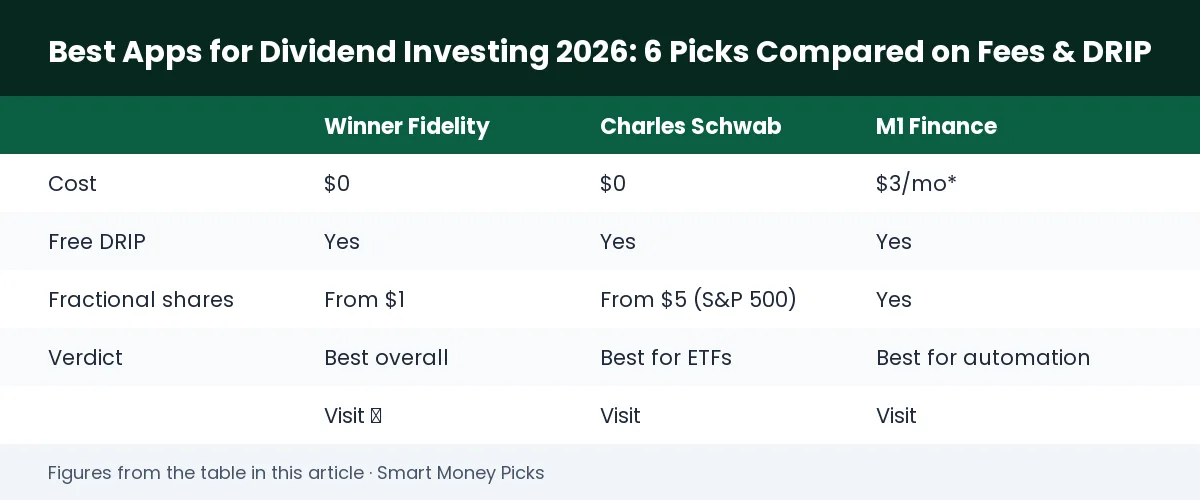
Our Top Picks at a Glance
| WinnerFidelity | Charles Schwab | M1 Finance | |
|---|---|---|---|
| Cost | $0 | $0 | $3/mo* |
| Free DRIP | Yes | Yes | Yes |
| Fractional shares | From $1 | From $5 (S&P 500) | Yes |
| Verdict | Best overall | Best for ETFs | Best for automation |
| Visit → | Visit | Visit |
*M1’s $3/mo platform fee is waived in any 30-day billing cycle where your M1 balance reaches $10,000 for at least one day, or with an active M1 Personal Loan.
Start compounding
Open a Fidelity account and turn on DRIP
*M1’s $3/month platform fee is waived in any 30-day billing cycle where your M1 balance reaches $10,000 for at least one day, or if you hold an active M1 Personal Loan.
Fidelity — Best App for Dividend Investing Overall
Fidelity is the app most dividend investors should start with. There are no account minimums, no trading commissions on U.S. stocks and ETFs, and its dividend reinvestment program is free. Turn on DRIP for a single position or your whole account and payouts automatically buy more shares — including fractional shares — instead of piling up as idle cash.
What sets Fidelity apart for dividend investing is the breadth of its fractional program. Its fractional-share trading lets you buy into more than 7,000 stocks and ETFs for as little as $1, so a small dividend can be reinvested across a much wider universe than rivals that limit slices to the S&P 500. Add genuinely strong research tools and a dividend view that shows projected annual income, and it covers nearly every base.
What we liked
- +Free DRIP with fractional reinvestment, account-wide or per position
- +Fractional buys from $1 across 7,000+ stocks and ETFs
- +No commissions, no account minimum
- +Clear projected-income and dividend tracking built in
Worth knowing
- –Interface is denser than a beginner app like Robinhood
- –No automated “pie” rebalancing like M1
Turn on DRIP and a $40 quarterly dividend never sits idle as cash.
Charles Schwab — Best for ETF Dividend Investors
Schwab runs one of the most flexible DRIP programs available. It’s free, covers thousands of stocks and ETFs, reinvests into fractional shares, and can be toggled on for your entire portfolio or just specific holdings. Commissions on U.S. stocks and ETFs are $0, and there’s no account minimum.
The one limit to know: Schwab’s “Stock Slices” fractional buying applies only to S&P 500 companies, with a $5 minimum per slice. That’s narrower than Fidelity’s 7,000-plus universe. For investors who build dividend portfolios mainly from large-cap dividend payers and broad dividend ETFs, that ceiling rarely bites — and Schwab lets you buy up to 30 different slices in one order, which is handy for spreading a payout across many names at once. For the full account-by-account matchup, see our Schwab vs Fidelity comparison.
M1 Finance — Best for Automated Dividend Portfolios
We reviewed this one separately in our full M1 Finance review, including how its Pies actually work in practice. M1 is built around “pies” — visual target portfolios where you set a percentage for each holding, and the app keeps you balanced as money comes in. Dividends drop into your cash balance and are automatically reinvested into the slices that are furthest below their target, which quietly rebalances the portfolio every time you get paid. For a hands-off dividend strategy, that automation is the main draw.
Pricing changed meaningfully: M1 retired its old $125/year M1 Plus subscription in 2024, and those premium perks are now standard. The one recurring cost is a $3/month platform fee, and it is waived in any 30-day billing cycle where your M1 balance reaches $10,000 for at least one day, or if you have an active M1 Personal Loan. Trading is commission-free and fractional shares are supported, so reinvested dividends are never left as drag.
Robinhood — Best for Beginners
If you want the simplest possible on-ramp to dividend investing, Robinhood is hard to beat. The app added automatic dividend reinvestment for most stocks and ETFs: switch on DRIP for a position and payouts buy fractional shares immediately, so even a $2 dividend goes straight back into the market. Trading is commission-free, fractional shares are supported, and there’s no account minimum.
The core experience is free. Robinhood Gold is optional at $5/month (or $50/year) and adds perks like a higher 3.6% APY on uninvested cash (as listed October 27, 2026) and IRA contribution matching — useful, but not required to run a dividend strategy. The trade-off versus Fidelity or Schwab is shallower research and fewer planning tools, which is the usual cost of that streamlined interface.
Vanguard — Best for Buy-and-Hold Index Investors
Vanguard is the natural home for investors who build dividend income out of low-cost index funds and ETFs. Its DRIP is free and works across individual stocks, ETFs, and mutual funds, reinvesting into fractional shares so dividends compound without manual effort. Mutual fund dividend investors get a real edge here: Vanguard’s own index funds reinvest in fractional units down to the penny, something stock-only apps can’t match.
Where Vanguard lags is fractional trading of individual stocks — fractional buying is limited to Vanguard ETFs, not single shares, and the app feels dated next to Robinhood or M1. But for someone dollar-cost-averaging into dividend ETFs and letting payouts reinvest for decades, the rock-bottom fund expense ratios matter more than a slick interface. Torn between the two index-fund giants? Our Fidelity vs Vanguard comparison covers it.
Snowball Analytics — Best Free App for Tracking Dividend Income
None of the brokerages above give you a great cross-account view of your dividend income, and that’s where a dedicated tracker helps. Snowball Analytics has a free plan that includes a dividend calendar, so you can see upcoming payouts across your holdings in one place. Empower’s free dashboard is a solid alternative if you also want broader net-worth tracking.
A tracker won’t place trades, but seeing next month’s expected payouts on a calendar is the single most motivating thing for a new dividend investor. Pair one with whichever brokerage you pick above.
How We Chose These Apps
We ranked apps on the factors that actually move dividend returns: the cost of trading and any recurring account fees, whether the dividend reinvestment plan is free and supports fractional shares, account minimums, and how much of the reinvestment can be automated. We prioritized free DRIP and fractional reinvestment because uninvested dividend cash is the most common drag on a small portfolio. We also checked that each app is a member of SIPC, which protects securities accounts up to $500,000 (including a $250,000 limit for cash) if the broker fails — note that SIPC does not protect against market losses.
Want to compare these against everyday money apps too? Our roundup of the best finance apps covers budgeting and saving tools, and you can browse more guides on the SmartMoneyPicks homepage.
Want to Go Deeper on Strategy?
An app handles the mechanics, but a framework helps you pick which dividend stocks to hold. Marc Lichtenfeld’s Get Rich with Dividends lays out a straightforward system for choosing dividend-growth payers and is one of the more practical reads for beginners building income portfolios.
Frequently Asked Questions
What is the best app for dividend investing in 2026?
Fidelity is the best app for dividend investing for most people in 2026. It charges no commissions or account minimums, offers free dividend reinvestment with fractional shares, and lets you buy slices of 7,000-plus stocks and ETFs from $1. Schwab and M1 are strong alternatives depending on whether you favor ETFs or fully automated portfolios.
Is dividend reinvestment (DRIP) free?
On Fidelity, Schwab, Robinhood and Vanguard, DRIP is free — there’s no charge to automatically reinvest dividends into more shares. M1 also reinvests at no per-trade cost, though it may charge a $3/month platform fee unless your balance reaches $10,000 on at least one day of the billing cycle.
Do I need a lot of money to start dividend investing?
No. Every brokerage on this list supports fractional shares and has no account minimum, so you can start with a few dollars. Fractional reinvestment means even small dividends are fully put back to work rather than sitting as cash.
Are dividend investing apps safe?
The brokerages here are SIPC members, which protects your securities up to $500,000 if the firm fails. That protection does not cover investment losses — dividend stocks can still fall in value, and dividends can be cut or suspended by the company paying them.
How are dividends taxed?
In a regular brokerage account, qualified dividends are taxed at the long-term capital gains rates (0%, 15% or 20%), while non-qualified dividends are taxed as ordinary income. Your broker sends a Form 1099-DIV once you receive $10 or more in a year, and dividends are taxed in the year they are paid even if DRIP reinvests them. Inside an IRA they are not taxed as they arrive. If you also have freelance or side income, Keeper’s Premium plan ($399 a year, read October 27, 2026) lists investors among the returns it handles and finds write-offs in your bank transactions; try Keeper free for 14 days (affiliate link: we earn a commission if you sign up, at no cost to you).
The Bottom Line
For most investors, Fidelity is the best app for dividend investing in 2026: free fractional DRIP, the widest slice selection, and no minimums. Choose Schwab if you build income mainly from S&P 500 names and dividend ETFs, M1 if you want a portfolio that rebalances itself on every payout, Robinhood if you’re just starting out, and Vanguard if you live in low-cost index funds. Whichever you pick, turn on automatic reinvestment from day one and pair it with a free tracker so you can watch the income compound.
The bottom line
Fidelity
Free fractional DRIP, the widest slice selection and no minimums — the best all-round home for dividend income.
Best overall
Disclosure: SmartMoneyPicks is a participant in the Amazon Associates program and may earn a commission from qualifying purchases made through Amazon links on this page. Brokerage links are provided for reference and are not paid placements.
This article is for informational purposes only and is not financial advice. Investing involves risk, including the possible loss of principal. Consider your own situation or consult a licensed financial professional before investing.