Best CD Rates of October 2026: Up to 4.95% APY From 6 Banks Compared
Some links on this page may become affiliate links, meaning we may earn a commission at no extra cost to you. See our affiliate disclosure. Editorial placement is decided on merit and is not for sale.
By Lennit Herrera, founder and editor, Smart Money Picks · Last updated October 1, 2026
The verdict: Synchrony Bank is the best all-round place to buy a CD this month. It has no minimum deposit, pays 4.20% APY on a 12-month CD and 4.50% APY on a 60-month CD, and its rates stay near the top at almost every term from 6 months to 5 years. If you have $10,000 or more and can leave it alone, Popular Direct pays the highest rates on this page — 4.80% to 4.95% APY on 3-, 4- and 5-year CDs — but it also charges the harshest early-withdrawal penalties. If you might need the money early, Marcus has the best no-penalty CD we found, at 4.00% APY for 11 months.
Rates verified against each bank’s own website or published rate feed on October 1, 2026. Popular Direct lists its rates as effective September 29, 2026, Ally lists October 1, 2026, and Marcus lists October 1, 2026. National averages come from the FDIC’s September 2026 National Rates table.
CD rates change often, sometimes weekly. Check the current APY on the bank’s site before you open an account. This article is general information, not financial advice.
On this page
- The short list: six picks at a glance
- Comparison table: best rate, minimum, penalty
- Best CD rate by term
- How we picked
- 1. Synchrony Bank: best overall
- 2. Popular Direct: best rates for $10,000 or more
- 3. Marcus by Goldman Sachs: best no-penalty CD
- 4. Bread Savings: best for pairing CDs with high-yield savings
- 5. Ally Bank: best for small deposits and mild penalties
- 6. CIT Bank: best for CIT savings customers
- Which CD is right for you
- Early-withdrawal penalties, compared in dollars
- How to build a CD ladder with these rates
- Is your money safe? FDIC coverage explained
- What didn’t make the list, and why
- When a CD is the wrong choice
- Frequently asked questions
The short list
- Synchrony Bank: best overall. No minimum deposit, 4.10% to 4.50% APY across most terms.
- Popular Direct: best rates if you have $10,000 or more, with 4.65% APY at 2 years and 4.95% APY at 5 years.
- Marcus by Goldman Sachs: best no-penalty CD, at 4.00% APY for 11 months, plus 4.40% APY on every term from 12 months to 6 years.
- Bread Savings: best for pairing CDs with savings. It pays 4.40% APY at 9 months and 4.50% APY at 18 months, and its high-yield savings account pays 4.00% APY.
- Ally Bank: best for small deposits. There is no minimum, and its early-withdrawal penalties are the mildest here.
- CIT Bank: best if you already keep savings at CIT. It pays 4.00% APY on a 1-year CD and 3.90% APY on an 11-month no-penalty CD.
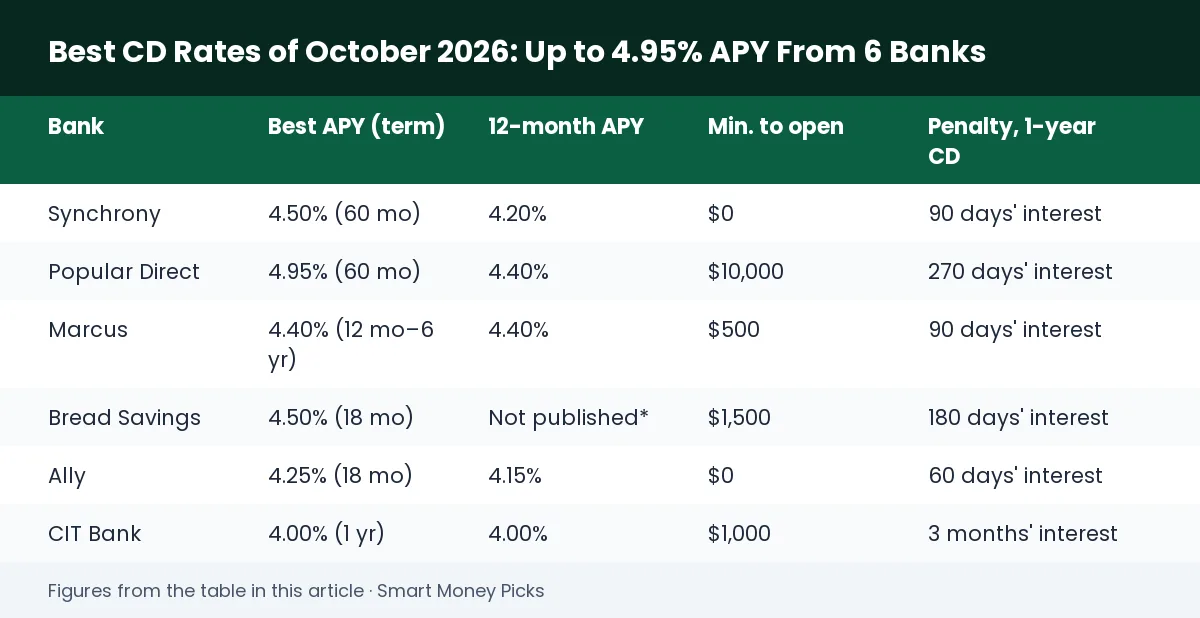
Comparison table
| Bank | Best APY (term) | 12-month APY | Min. to open | Penalty, 1-year CD | Go |
|---|---|---|---|---|---|
| Synchrony | 4.50% (60 mo) | 4.20% | $0 | 90 days’ interest | See Synchrony CDs → |
| Popular Direct | 4.95% (60 mo) | 4.40% | $10,000 | 270 days’ interest | See Popular Direct CDs → |
| Marcus | 4.40% (12 mo–6 yr) | 4.40% | $500 | 90 days’ interest | See Marcus CDs → |
| Bread Savings | 4.50% (18 mo) | Not published* | $1,500 | 180 days’ interest | See Bread Savings → |
| Ally | 4.25% (18 mo) | 4.15% | $0 | 60 days’ interest | See Ally CDs → |
| CIT Bank | 4.00% (1 yr) | 4.00% | $1,000 | 3 months’ interest | See CIT CDs → |
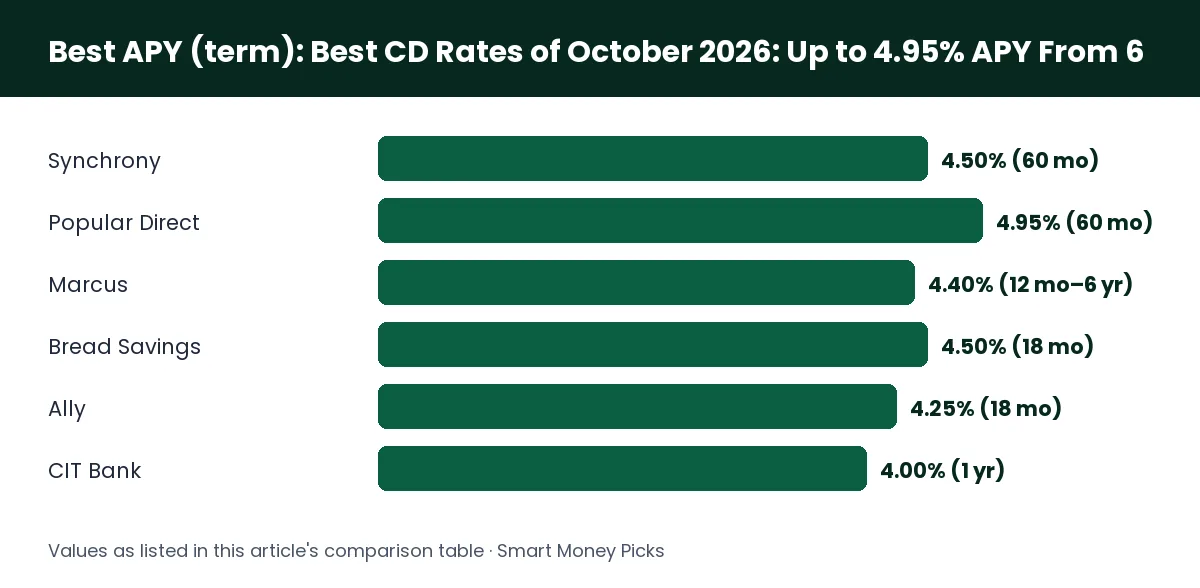
*Bread’s public page features only its 9-month (4.40% APY) and 18-month (4.50% APY) CDs. It says terms run from 3 months to 5 years, but it doesn’t show rates for the other terms without starting an application, so we haven’t listed any. All rates are APY, verified October 1, 2026.
Best CD rate by term
Most people shop by term, not by bank. You know roughly when you’ll need the money, and you want the best rate for that date. This table shows the top verified APY at each common term among the six banks above.
| Term | Best APY found | Bank | Best with no minimum | FDIC national avg. |
|---|---|---|---|---|
| 3 months | 4.15% | Popular Direct | 2.80% (Ally) | 1.13% |
| 6 months | 4.25% | Popular Direct | 4.10% (Synchrony) | 1.41% |
| 9 months | 4.40% | Bread ($1,500 min.) | 4.15% (Synchrony) | not published |
| 12 months | 4.40% | Popular Direct, Marcus | 4.20% (Synchrony) | 1.73% |
| 18 months | 4.55% | Popular Direct | 4.35% (Synchrony) | not published |
| 24 months | 4.65% | Popular Direct | 4.35% (Synchrony) | 1.61% |
| 36 months | 4.80% | Popular Direct | 4.40% (Synchrony) | 1.36% |
| 48 months | 4.85% | Popular Direct | 4.40% (Synchrony) | 1.28% |
| 60 months | 4.95% | Popular Direct | 4.50% (Synchrony) | 1.38% |
Two things stand out. First, every bank on this list pays more than double the national average at nearly every term. The FDIC’s September 2026 figure for a 12-month CD is 1.73%, while the best rate here is 4.40% APY. On $10,000, that’s $173 versus $440 of interest over one year. Second, this is not the usual shape where longer terms always pay more. Marcus pays the same 4.40% APY from 12 months through 6 years. Synchrony’s 13-month CD (4.40% APY) pays as much as its 36- and 48-month CDs, and more than its 24-month CD (4.35%). Ally’s 24-month CD pays less than its 12-month. So compare the specific term you need, not the bank’s headline rate.
How we picked
We compared CD offers from nine online banks. For each one, we used the bank’s own website or its own published rate data, all checked on October 1, 2026. Six made the list. Three were left off because their current rates were lower or because we couldn’t confirm them at the source (details below). For the national averages, we used the FDIC’s published National Rates table. To confirm every bank’s FDIC insurance, we looked it up in the FDIC’s own BankFind database.
We ranked banks on four things, in this order:
- The rate across the terms people actually buy, meaning 6 months to 5 years, not just one standout promo term.
- The minimum deposit. A great rate with a $10,000 minimum doesn’t help someone saving $2,000.
- The early-withdrawal penalty. This is the cost you pay if your plans change, and it varies more than the rates do. Penalties range from 60 days’ interest at Ally to 730 days’ interest on Popular Direct’s longest CDs.
- How clear the bank is about its rates. Banks that show every term and its date on their public site ranked higher than banks that hide some terms behind an application.
We do not open or test accounts ourselves. Nothing here comes from personal use. Rates, minimums and penalty rules come from each bank’s published pages and disclosures. Where a bank shows a rate date, we’ve included it. CD rates can change quickly, so treat every figure here as a snapshot from October 1, 2026, not a promise.
1. Synchrony Bank: best overall
- Top APY: 4.50% (60 months)
- 12-month APY: 4.20%
- Min. deposit to open: $0
- Early-withdrawal penalty: 90 days’ simple interest (12 months or less) · 180 days (more than 12 but less than 48 months) · 365 days (48 months or more)
- FDIC insured: Yes, Synchrony Bank (FDIC cert. 27314)
Why Synchrony? Many banks have one standout term. Synchrony is strong at almost every term. From its own rate data: 4.10% APY at 6 months; 4.15% at 9 months; 4.20% at 12 months; 4.40% at 13 months; 4.30% at 14, 15 and 16 months; 4.35% at 18, 19 and 24 months; 4.40% at 36 and 48 months; and 4.50% at 60 months. The rate is the same at every balance, so a $500 CD earns the same APY as a $100,000 one. There’s no minimum deposit. That means you can open several CDs at different terms (a ladder, explained below) without needing a large sum for each. One more detail: you can add money during the 10-day grace period after a CD matures, which some banks don’t allow.
What we like
- No minimum deposit, and the same rate at every balance.
- Terms from 3 months to 5 years, including in-between terms like 13, 14, 15, 16 and 19 months.
- 4.50% APY on the 5-year CD, the best long-term rate here that has no minimum.
- You can add money during the 10-day grace period at maturity.
Watch out for
- Its no-penalty CD pays only 0.25% APY. That’s far below Synchrony’s own savings account. Skip it and use Marcus or CIT instead.
- The 3-month CD also pays 0.25% APY, so don’t use Synchrony for very short terms.
- CDs of 48 months or longer carry a 365-day interest penalty. Breaking a 5-year CD costs a full year of interest.
- The 24-month Bump-Up CD pays just 3.00% APY. That’s 1.35 points below the regular 24-month CD, which is a steep price for one chance to raise your rate later.
Best for: most savers, especially anyone building a ladder or starting with a small deposit. Skip it if: you need a CD shorter than 6 months, or a no-penalty CD.
See Synchrony’s current CD rates →
2. Popular Direct: best rates for $10,000 or more
- Top APY: 4.95% (60 months)
- 12-month APY: 4.40%
- Min. deposit to open: $10,000
- Early-withdrawal penalty: 89 days’ simple interest (under 91 days) · 120 days (91 days to under 12 months) · 270 days (12 to under 36 months) · 365 days (36 to under 60 months) · 730 days (60 months or more)
- FDIC insured: Yes, through Popular Bank (FDIC cert. 34967)
Why Popular Direct? It pays the highest rate on this list at almost every term: 4.15% APY at 3 months, 4.25% at 6 months, 4.40% at 12 months, 4.55% at 18 months, 4.65% at 24 months, 4.80% at 36 months, 4.85% at 48 months and 4.95% at 60 months. Its product page lists all of these as effective September 29, 2026. Its CD disclosure says rates are “set weekly based on market conditions,” so they can move quickly. Popular Direct is the online arm of Popular Bank. The disclosure notes that balances at Popular Direct and Popular Bank count together for FDIC coverage. If you already bank with Popular Bank, that matters (more below).
What we like
- The highest APY we found at 3, 6, 12 (tied with Marcus), 18, 24, 36, 48 and 60 months.
- Its public site lists every term, rate and effective date.
- Rates rise steadily with the term, unlike some banks on this list.
Watch out for
- These are the harshest penalties on this page. Breaking a 5-year CD costs 730 days of simple interest, which is two full years. On $10,000 at its 4.83% interest rate, that’s about $965. Breaking a 1-year CD costs 270 days of interest, three times what Synchrony or Marcus charge.
- The $10,000 minimum rules out many savers, and you can’t build a ladder in smaller pieces.
- With rates set weekly, the rate you see today may change before you fund the account. Check it on the day you open.
Best for: savers with $10,000 or more who are confident they won’t touch it before maturity. Skip it if: there’s any real chance you’ll need the money early. The penalty can wipe out the rate advantage and then some.
See Popular Direct’s current CD rates →
3. Marcus by Goldman Sachs: best no-penalty CD
- Top APY: 4.40% (High-Yield CD, 12 months through 6 years)
- 12-month APY: 4.40%
- Min. deposit to open: $500
- Early-withdrawal penalty: 90 days’ interest (1 year or less) · 180 days (more than 1 year to 5 years) · 270 days (more than 5 years); none on No-Penalty CDs
- FDIC insured: Yes, Goldman Sachs Bank USA (FDIC cert. 33124)
Why Marcus? It offers two very different products, and both are among the best here. Its No-Penalty CD pays 4.00% APY for 11 months (3.75% for 7 months, 3.80% for 13 months). Marcus says you can withdraw your full balance starting seven days after funding. That’s the best no-penalty rate we found, ahead of CIT’s 3.90% and well ahead of Ally’s 2.80%. Its High-Yield CD pays 4.40% APY on every term from 12 months to 6 years, plus 4.30% at 9 months. Marcus’s rate data is dated October 1, 2026. For comparison, its Online Savings Account pays 3.50% APY. So the 11-month No-Penalty CD earns 0.50 points more than Marcus’s savings account and still lets you leave early without a penalty.
What we like
- The best no-penalty CD rate on this list, with a $500 minimum.
- The same 4.40% APY from 12 months to 6 years, so you can take a shorter term at no cost in rate.
- Moderate penalties: 180 days’ interest up to 5 years, versus 365 days at Synchrony and 730 days at Popular Direct on their 5-year CDs.
- It clearly explains how its penalty is calculated, with the formula published on its CD guide.
Watch out for
- The 11-month No-Penalty CD (4.00% APY) pays 0.40 points less than the 12-month High-Yield CD (4.40%). That gap is the price of being able to leave without a penalty. If you’re sure you won’t need the money, the 12-month CD pays more.
- No-Penalty CD withdrawals must be the full balance. You can’t take out part of it.
- The penalty is based on your original deposit, and Marcus’s penalty rules describe withdrawing the entire principal, so plan on closing the whole CD rather than taking out part of it.
- The Rate Bump CD (20 months, 4.35% APY) pays 0.05 points below the regular 18- or 24-month CD. That’s a small price for the option to raise your rate once, but it still starts lower.
Best for: anyone who wants a CD-level rate but might need the money within the year, and savers who want a long term without a long-term penalty. Skip it if: you want the very top rate at 18 months or longer. Popular Direct pays more there, though it needs $10,000 and has the harshest penalties.
See Marcus No-Penalty CD → · See Marcus High-Yield CD rates →
4. Bread Savings: best for pairing CDs with high-yield savings
- Top APY: 4.50% (18 months)
- 12-month APY: not shown on its public page
- Min. deposit to open: $1,500
- Early-withdrawal penalty: 90 days’ simple interest (under 12 months) · 180 days (12 months to 3 years) · 365 days (4 years and up)
- FDIC insured: Yes, through Comenity Capital Bank (FDIC cert. 57570)
Why Bread? Its featured 9-month CD pays 4.40% APY, the best 9-month rate on this list (Marcus pays 4.30%). Its 18-month CD pays 4.50% APY, second only to Popular Direct (4.55%) at that term and ahead of Marcus (4.40%), with a much lower minimum than Popular’s. What sets Bread apart is its high-yield savings account at 4.00% APY, higher than the savings rates at Synchrony, Marcus, Ally and CIT. If you want your flexible savings and your CDs at one bank, Bread pays well on both. Bread Savings is the deposit brand of Comenity Capital Bank. Its account agreement spells out a clear three-tier penalty schedule and a 10-day grace period at maturity.
What we like
- A 4.00% APY high-yield savings account alongside its CDs.
- 4.40% APY for 9 months with only a 90-day interest penalty.
- 4.50% APY at 18 months with a $1,500 minimum, versus Popular Direct’s $10,000.
- A clear, published penalty schedule and a 10-day grace period.
Watch out for
- Only two terms show rates on Bread’s public page. It says CDs run from 3 months to 5 years, but other rates aren’t shown before you apply. We don’t list rates we couldn’t verify.
- The $1,500 opening deposit must be made in a single transaction.
- At maturity, CDs renew automatically at Bread’s base rate for that term, which may be lower than the featured rate you opened at. Set a reminder for the grace period.
- CDs of 12 months to 3 years carry a 180-day penalty, double what Synchrony and Marcus charge on a 12-month CD.
Best for: anyone with $1,500 or more who wants a 9- or 18-month CD and a strong savings account at the same bank. Skip it if: you want to compare every term on one public page first, or you want a lower minimum than $1,500 (Marcus starts at $500 and pays 4.30% APY at 9 months).
5. Ally Bank: best for small deposits and mild penalties
- Top APY: 4.25% (18 months)
- 12-month APY: 4.15%
- Min. deposit to open: $0
- Early-withdrawal penalty: 30 days’ interest (under 3 months) · 60 days (3–24 months) · 90 days (25–36 months) · 120 days (37–48 months) · 150 days (49 months or longer)
- FDIC insured: Yes, Ally Bank (FDIC cert. 57803)
Why Ally? It has the mildest penalties on this list. Ally charges 60 days’ interest on any term from 3 to 24 months, and just 150 days on 5-year CDs. Synchrony charges 365 days and Popular Direct charges 730 days on their 5-year CDs. On a $10,000, 12-month Ally CD, breaking early costs about $67 in interest. Ally’s rates, dated October 1, 2026, are 4.15% APY at 12 months, 4.25% at 18 months, 4.00% at 9 months, 3.85% at 6 months, 4.00% at 3 years and 4.10% at 5 years. There’s no minimum deposit. Ally also has a Ten Day Best Rate Guarantee on its High Yield and No Penalty CDs: if you fund within 10 days of opening and Ally’s rate for your term rises in that window, you get the higher rate.
What we like
- The lowest early-withdrawal penalties of any bank here, at every term length.
- No minimum deposit, and the same rate at every balance tier.
- The Ten Day Best Rate Guarantee protects you if rates rise right after you open.
- 4.10% APY on the 5-year CD with only a 150-day penalty is a good fit for anyone unsure about a long lock-up.
Watch out for
- The No Penalty CD pays only 2.80% APY, below Ally’s own 3.10% APY savings account. For a no-penalty CD, Marcus pays 4.00%.
- Rates are uneven by term. The 24-month (Raise Your Rate) CD and the 4-year CD pay 3.00% APY, less than the 12-month.
- Ally doesn’t allow partial early withdrawals. Breaking a CD means closing the whole thing.
- Its best rates are a notch below Synchrony’s and Popular Direct’s at most terms.
Best for: small deposits, first-time CD buyers, and anyone who thinks they might need to break the CD. Skip it if: you’re certain you’ll hold to maturity and want the highest possible rate.
6. CIT Bank: best for CIT savings customers
- Top APY: 4.00% (1-Year Term CD)
- 12-month APY: 4.00%
- Min. deposit to open: $1,000
- Early-withdrawal penalty: 3 months’ simple interest (terms up to 1 year) · 6 months (more than 1 year up to 3 years) · 12 months (more than 3 years); none on the No-Penalty CD
- FDIC insured: Yes, CIT Bank is a division of First-Citizens Bank & Trust Company (FDIC cert. 11063)
Why CIT? CIT’s two best CDs are its 1-Year Term CD at 4.00% APY and its 11-month No-Penalty CD at 3.90% APY. CIT says you can withdraw from the No-Penalty CD, including the interest earned, starting seven days after the money arrives. That’s the second-best no-penalty rate on this list, behind Marcus. The 6-month CD pays 3.75% APY. The case for CIT is strongest if you already use its Platinum Savings account, which pays 3.75% APY on balances of $5,000 or more. You can keep your flexible cash and a fixed-rate CD at one bank and move money between them without waiting on transfers from another bank.
What we like
- A 3.90% APY no-penalty CD, far ahead of Ally’s (2.80%) and Synchrony’s (0.25%).
- 4.00% APY for one year, with a moderate 3-month interest penalty.
- A 10-day grace period at maturity.
- It pairs well with Platinum Savings for anyone keeping $5,000 or more at CIT.
Watch out for
- Several terms pay much less. The 13-month CD pays 3.25% APY and the 18-month pays 2.75% APY. At 18 months, that’s 1.65 to 1.80 points below Marcus, Bread and Popular Direct.
- The 13-month and 18-month CDs don’t renew into the same term. CIT renews the 13-month as a 1-Year Term CD and the 18-month as a 2-Year Term CD, at whatever rate is posted then.
- CIT’s rate pages load in the browser, and we couldn’t confirm its 2- to 5-year Term CD rates from the source. Check those terms on CIT’s site before buying.
- The $1,000 minimum is higher than Synchrony’s, Ally’s or Marcus’s.
Best for: existing CIT savers, and anyone who wants a 1-year or no-penalty CD at a bank that also has a strong savings account. Skip it if: you want a 13- to 18-month term. Other banks here pay far more.
See CIT’s No-Penalty CD → · See CIT Term CDs →
Read our full CIT Bank Platinum Savings review →
Which CD is right for you
You have $10,000 or more and a firm date 3 to 5 years out. Popular Direct at 4.95% APY is the top rate. Only choose it if the date is truly fixed, because breaking a 5-year CD costs two years of interest. If you want some protection against a change of plans, Marcus at 4.40% APY has a 180-day penalty up to 5 years. You give up 0.55 points of rate in exchange for a much smaller penalty.
You’re starting small, with a few hundred dollars. Synchrony and Ally have no minimum. Synchrony pays more at most terms, while Ally has the milder penalties. Marcus works from $500.
You might need the money within a year. Use a no-penalty CD: Marcus (4.00% APY, 11 months) or CIT (3.90% APY, 11 months). Both beat most savings accounts, and you keep the right to withdraw without a penalty. Compare them against our best high-yield savings accounts, since a strong savings account may be close enough.
You’re saving for a known expense 6 to 18 months away, like tuition, a wedding or a car. Look at Synchrony (4.10% APY at 6 months, 4.20% at 12 months), Bread (4.40% APY at 9 months), Marcus (4.40% APY at 12 or 18 months) or the 18-month CDs from Popular Direct (4.55% APY) and Bread (4.50% APY). Pick the term that ends just before the bill is due.
You want a ladder. Synchrony is the easiest single bank for this: no minimum and strong rates at every rung. See the ladder section.
This is your emergency fund. Don’t put it in a regular CD. Our emergency fund guide explains why. A no-penalty CD is the only CD that fits that purpose, and a high-yield savings account usually fits better.
Early-withdrawal penalties, compared in dollars
Most CD roundups barely mention penalties, even though a penalty is the cost of a CD that goes wrong. Every bank here calculates it as a number of days (or months) of interest. That means the dollar cost depends on your rate and deposit, and the gap between banks can be large.
Here’s how the rules compare for a 5-year CD:
| Bank | 5-year APY | Penalty on a 5-year CD | Rough cost on $10,000 |
|---|---|---|---|
| Ally | 4.10% | 150 days’ interest | about $165 |
| Marcus | 4.40% | 180 days’ interest | about $212 |
| Synchrony | 4.50% | 365 days’ interest | about $440 |
| Popular Direct | 4.95% | 730 days’ interest | about $965 |
Estimates use each bank’s published interest rate where available (Marcus 4.31%, Synchrony 4.40%, Ally 4.02%, Popular Direct 4.83%) and simple interest on the original $10,000. Your actual penalty depends on your rate and the bank’s own calculation. Bread charges 365 days on 4-year-and-up CDs, and CIT charges 12 months on terms over 3 years; we couldn’t confirm their 5-year rates, so they aren’t in this table.
The practical point: Popular Direct’s 0.55-point rate advantage over Marcus is worth about $55 a year on $10,000. Its extra penalty if you break the CD is roughly $750. So you would need to be very sure you won’t break it for that choice to make sense.
Two more details matter. A penalty can reach your principal. Ally says its penalty comes out of accrued interest first and then, if needed, from principal. Break a CD in its first few months and you can get back less than you put in. Partial early withdrawals are often not allowed. Ally says so outright, and Marcus’s penalty rules describe withdrawing the entire principal. If you think you might need part of the money, split it across two or three smaller CDs instead of one large one.
How to build a CD ladder with these rates
A ladder splits your money across several CDs that mature at different times, so some cash comes free on a regular schedule. You avoid locking everything into one rate, and you avoid a large penalty if you need part of the money.
A simple five-rung ladder with $10,000 at Synchrony, using today’s rates:
- $2,000 in a 12-month CD at 4.20% APY
- $2,000 in a 24-month CD at 4.35% APY
- $2,000 in a 36-month CD at 4.40% APY
- $2,000 in a 48-month CD at 4.40% APY
- $2,000 in a 60-month CD at 4.50% APY
When the 12-month CD matures, move it into a new 60-month CD. After four years, every rung is a 5-year CD, and one matures every year. In this example, every rung from 24 months up pays 4.35% to 4.50% APY. If you prefer, you could put a rung at Marcus instead (4.40% APY on any term from 12 months to 6 years, $500 minimum). Ladders can span several banks. The only cost is more accounts to track.
For shorter goals, use a mini-ladder of 3-, 6-, 9- and 12-month CDs. Some cash frees up every quarter, which is useful when you’re parking a lump sum and aren’t sure yet when you’ll need it.
How much does a ladder earn? On $10,000 at 4.50% APY for five years, interest compounds to about $2,462. At the FDIC’s national average 5-year rate of 1.38%, the same deposit earns about $709. For more examples like this, see our breakdown of how much interest $10,000 earns.
Is your money safe? FDIC coverage explained
All six banks are FDIC-insured, and we confirmed each one in the FDIC’s BankFind database. The FDIC’s standard coverage is $250,000 per depositor, per insured bank, per ownership category, as it explains in its deposit insurance guide. A CD counts toward that limit the same way a savings account does.
Two things catch people out:
- Brand names can share one bank. Popular Direct deposits are held at Popular Bank, and its disclosure says balances at both are combined for insurance. CIT Bank is a division of First-Citizens Bank & Trust Company, so money at CIT and at First Citizens counts together. Bread Savings is Comenity Capital Bank. Marcus is Goldman Sachs Bank USA.
- Interest counts toward the limit. A $250,000 CD that earns interest will go above the cap. If you’re near the limit, spread your money across banks or use different ownership categories, such as joint accounts or retirement accounts.
If you’re moving money into a CD from a fintech app, make sure the CD is at an FDIC-insured bank. Apps like Chime, Current and Varo are not banks, and deposit insurance only applies through their partner banks. None of the six CDs here involve a middleman. Each is opened directly with the insured bank.
What didn’t make the list, and why
- Quontic Bank. It has a low $500 minimum, but its top CD rate is 3.60% APY (3 months), and its 5-year CD pays 2.75% APY. Its site says these rates took effect June 18, 2026. That’s well below every pick here at 12 months and longer.
- Capital One 360. It has no minimum and publishes its penalty rules (3 months’ interest on terms of 12 months or less, 6 months’ interest on longer terms). But its rate table loads in the browser, and we couldn’t confirm the actual rates from the bank itself. We don’t list rates we can’t verify.
- American Express. Its CD page says there’s no minimum balance. We couldn’t confirm its current CD rates on Amex’s own site, so it’s not included. (A competitor’s comparison showed Amex CD rates below 3.50% APY. We don’t treat that as a primary source.)
- Synchrony’s and Ally’s no-penalty CDs. We kept both banks but not these products. At 0.25% and 2.80% APY, both pay less than the same bank’s own savings account.
- Brokered CDs. These are sold through brokerages and work differently: you can sell them on a secondary market instead of paying a penalty, but the price can drop. They’re a separate topic and not compared here.
When a CD is the wrong choice
A CD does one thing well. It locks in a rate for a set period, and your money isn’t tied to the stock market. That doesn’t make it the right tool for every goal.
- Money you might need any day. Emergency funds and irregular bills belong in a savings or money market account. See our money market vs high-yield savings comparison and high-yield savings vs CD guide. Right now, a good savings account pays close to a short-term CD without any lock-up.
- Money you won’t touch for 10 years or more. Over long periods, a fixed rate usually trails a diversified stock fund. The trade-off is that stocks can lose value in any given year. If long-term growth is the goal, read how to invest in index funds.
- When inflation outpaces your rate. A CD’s rate is fixed. If inflation rises above it, your money loses buying power over the term.
- When rates might rise. Locking in for five years means missing out if rates go up. Bump-up CDs try to address this, but at Synchrony and Ally they pay much less upfront, and Marcus’s Rate Bump CD starts 0.05 points below its regular CD. A ladder is usually the cheaper answer.
CD interest is also taxable as ordinary income in the year it’s credited, even if you leave it in the CD. The exception is a CD held inside an IRA. Ask a tax professional how this applies to you.
Frequently asked questions
What is the best CD rate right now?
Among the banks we checked on October 1, 2026, the highest was Popular Direct’s 4.95% APY on a 60-month CD, with a $10,000 minimum. With no minimum, the best was Synchrony’s 4.50% APY on a 60-month CD. For a 12-month CD, the best was Popular Direct and Marcus at 4.40% APY, followed by Synchrony at 4.20% APY.
Are CD rates going up or down?
We don’t forecast rates. What we can say: several banks here now pay the same or less for longer terms. Marcus pays the same 4.40% APY from 12 months to 6 years, and Synchrony’s 13-month rate matches its 36- and 48-month rates. When long terms don’t pay more than short ones, banks are generally not expecting rates to rise much. Rates can still change at any time.
How much does a $10,000 CD earn in a year?
At 4.40% APY for 12 months (Popular Direct or Marcus), you’d earn $440. At 4.20% APY (Synchrony), $420. At 4.15% APY (Ally), $415. At 4.00% APY (CIT), $400. At the FDIC’s 1.73% national average, $173. APY already includes compounding, so for a one-year term, the APY times the deposit gives you the interest.
What happens when a CD matures?
You get a grace period, usually 10 days at the banks here, to withdraw, add money (at some banks) or change terms without a penalty. If you do nothing, most banks renew the CD automatically at their current rate for that term, which may be lower than what you had. Bread renews at its base rate. CIT renews its 13-month and 18-month CDs into different terms. Mark the maturity date on your calendar.
Can you lose money in a CD?
Not from market swings, and FDIC insurance covers your principal and interest up to the limit if the bank fails. You can lose money by breaking a CD early, though. If the penalty is larger than the interest you’ve earned so far, the rest comes from your principal. That’s why penalty size matters as much as the rate.
Is a no-penalty CD worth it?
Only if it pays more than a good savings account. Marcus’s 4.00% APY no-penalty CD beats its own 3.50% APY savings account, and CIT’s 3.90% beats the 3.75% APY its Platinum Savings account pays on $5,000 or more. But Ally’s 2.80% and Synchrony’s 0.25% no-penalty CDs pay less than the same banks’ savings accounts, so they’re not worth it. The rate is locked for the term, which protects you if savings rates fall.
How many CDs can I have?
We didn’t find a published limit on the number of CDs one customer can open in the pages we reviewed at these six banks, and a ladder depends on holding several. Some banks do cap the maximum deposit per CD. Marcus’s rate data lists a $1,000,000 maximum, for example. What matters in practice is keeping your total at each bank under the FDIC limit and tracking each maturity date.
Bottom line
For most people, Synchrony is the place to start. It has no minimum, 4.20% APY for a year and 4.50% APY for five years, with strong rates in between. If you have $10,000 or more and a date you’re sure of, Popular Direct’s 4.95% APY is the top rate here, but its penalty can cost two years of interest. If you might need the money, Marcus’s 4.00% APY no-penalty CD is the best way to get a CD-level rate without the lock-up. Ally is the forgiving choice if you think you might break the CD, and CIT fits best if your savings already live there.
Whichever bank you choose, pick the term that matches your date, compare the penalty as well as the rate, and check the live rate on the bank’s site the day you open. CD rates here can change within a week.
About the author
Lennit Herrera is the founder and editor of Smart Money Picks, and he builds and audits websites for a living. Lennit is not a licensed financial adviser, and nothing here is personal financial advice. We do not open or test accounts. Rates and fees come from the banks’ own disclosures or named public sources such as the FDIC, and each one is dated. Corrections are welcome through our contact page.
Related reads