Betterment Review 2026: Fees, Features & Is It Worth It?
Betterment helped invent the robo-advisor category in 2010, and it is still one of the largest independent ones: it reports more than $70 billion in assets under management (as of May 10, 2026) and more than 1 million customers (as of August 18, 2026). The space is crowded now, though, and free brokerages give away a lot of what used to cost money. So the real question for this Betterment review 2026 isn’t whether the platform works. It’s whether the $5 a month or 0.25% a year you pay actually earns its keep. Here’s what you get, what it costs today, and who should skip it.
Disclosure: Betterment does not pay us, and the Betterment links on this page are not affiliate links. Betterment LLC is an SEC-registered investment adviser, and we do not act as a paid promoter for it or any other adviser. The one affiliate link on the page is to a book on Amazon, near the end. This is not financial advice; do your own research or talk to a licensed advisor before investing.
Quick answer: Betterment costs $5 a month until you set up $200 a month in recurring deposits or reach $24,000, then 0.25% a year ($25 per $10,000). Premium, with unlimited access to Certified Financial Planner professionals, is 0.65% with a $100,000 minimum. Cash Reserve pays 3.50% APY (variable), plus a 0.75% boost for new clients through February 15, 2027. It is worth it for hands-off investors who will set up the $200 deposit; a confident DIY investor pays less elsewhere. Every figure here was re-read on Betterment’s own pages on November 6, 2026.
What Is Betterment?
Betterment is an automated investing platform, a robo-advisor, that builds and manages a diversified portfolio of low-cost ETFs for you based on your goals and risk tolerance. You answer a few questions, pick a goal (retirement, a house, general investing), and the software handles allocation, rebalancing, dividend reinvestment and tax strategy in the background. It’s built for people who want their money invested sensibly without picking stocks or watching the market. Alongside investing, Betterment offers a high-yield cash account, a no-fee checking account and, on its upper tier, access to human financial planners.
Key Features
Goal-based automated portfolios
Instead of one generic account, Betterment lets you set up separate goals, each with its own target date, risk level and glide path. A retirement goal 30 years out holds more stock; a house down payment you need in two years shifts toward bonds as the date approaches. The portfolios are built from ETFs whose fund fees are charged inside the funds. Betterment says it receives no portion of those fund fees and that they come on top of its own management fee.
Tax-loss harvesting and asset location
On taxable accounts, Betterment sells investments that have dropped in value to realize a loss, then buys similar investments so you stay invested. Those losses can offset capital gains and up to $3,000 of ordinary income a year. Betterment says 66% of its customers using its tax-loss harvesting features had their Betterment fee covered by likely tax savings; that is Betterment’s own figure, and it also states that tax-loss harvesting is not suitable for all investors. The feature does nothing inside an IRA. A second tax feature, asset location, places higher-tax bonds in your IRAs and lower-tax stocks in taxable accounts when you hold both at Betterment. Neither feature looks at investments you hold elsewhere.
Cash Reserve and Checking
Cash Reserve pays 3.50% APY (variable, as of 9/21/2026 on Betterment’s page, re-read November 6), and new clients with a qualifying deposit get a 0.75% APY boost on up to $1 million through February 15, 2027 (terms on Betterment’s site). There are no fees, and the base rate needs only a $10 deposit. Eligible cash is FDIC-insured up to $4 million for an individual ($8 million joint) by spreading it across Betterment’s program banks, subject to conditions. Betterment Checking, issued by nbkc bank, has no overdraft fees or minimum balance, reimburses ATM fees, and reimburses the Visa 1% foreign transaction fee; it is FDIC-insured up to $250,000 per depositor at nbkc bank. Neither account is always the highest rate on the market, but cash and investments sit under one login. If you are building the cash cushion first, our emergency fund guide compares current savings rates.
Retirement accounts and rollovers
Traditional, Roth and SEP IRAs are all supported, and Betterment will walk you through rolling over an old 401(k). If retirement is your main goal, this is where the automation earns the most trust: set a monthly deposit, pick a target, and leave it alone. For a plan built around a smaller first deposit, read how to start investing with $500.
Premium: human planners
Premium adds unlimited access to Betterment’s team of Certified Financial Planner professionals, who can advise on your Betterment portfolio and on accounts you hold elsewhere. It is the main thing that separates Betterment from software-only rivals.
Pricing
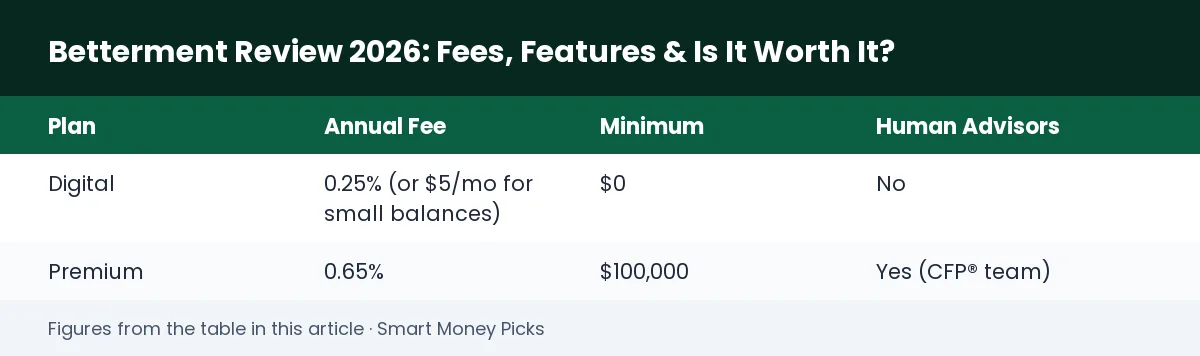
Betterment runs two tiers. The Digital plan costs 0.25% a year on your invested balance, which is $25 a year for every $10,000. The catch is the starting price: investing accounts begin at a flat $5 a month, and you switch to the 0.25% annual fee once you set up recurring monthly deposits or transfers totaling $200 or more, or once your Betterment balance (Cash Reserve included) reaches $24,000. On a $5,000 balance with no recurring deposit, $5 a month is $60 a year, or 1.2% of the balance, so setting up the $200 monthly deposit is the cheapest move for a small account. There’s no minimum to open a Digital account.
The Premium plan costs 0.65% a year on the first $1 million (the 0.25% Digital fee plus 0.40% for advice) and requires $100,000 in eligible investments per household. Above $1 million in household investing balances, the fee drops to 0.15% on the portion between $1 million and $2 million and 0.10% above $2 million.
| Plan | Annual Fee | Minimum | Human Advisors |
|---|---|---|---|
| Digital | $5/mo, or 0.25% with $200/mo deposits or a $24,000 balance | $0 | No |
| Premium | 0.65% on the first $1M | $100,000 | Yes (CFP® team) |
Other fees
There are no trading commissions or deposit fees, and withdrawing to your linked checking account is free. The fee to know about is on the way out: Betterment Securities charges a flat $75 for each investing account you transfer to another company. Selling and withdrawing cash avoids it but can trigger taxes in a taxable account, so plan for it if you think you may move later.
What Betterment costs at different balances
Here is the Digital fee worked out from Betterment’s published pricing, next to Vanguard Digital Advisor’s 0.20% gross fee for its index portfolios (Vanguard’s own page says the net cost works out to about $15 to $16 per $10,000). Fund expense ratios come on top for both.
| Balance | Betterment, no recurring deposit | Betterment, $200/mo deposit | Vanguard Digital Advisor (0.20% gross) |
|---|---|---|---|
| $5,000 | $60/yr | $12.50/yr | $10/yr |
| $10,000 | $60/yr | $25/yr | $20/yr |
| $25,000 | $62.50/yr (over $24,000, so 0.25%) | $62.50/yr | $50/yr |
| $50,000 | $125/yr | $125/yr | $100/yr |
| $100,000 | $250/yr Digital, $650/yr Premium | $250/yr Digital, $650/yr Premium | $200/yr |
The gap to Vanguard is small at most balances; the $5 monthly fee on a small account with no recurring deposit is the one cost that really stings. A plain index-fund portfolio you manage yourself at a free brokerage costs nothing in advisory fees. You’re paying Betterment for the automation, the interface and the tax features, not for cheaper funds.
Is Betterment Safe?
Betterment LLC is an SEC-registered investment adviser, and your investments are held at Betterment Securities, an SEC-registered broker-dealer and member of FINRA and SIPC. SIPC protects securities customers of its members up to $500,000, including $250,000 for claims for cash, if the brokerage itself fails; it does not protect you from market losses. Cash in Cash Reserve is swept to program banks for FDIC insurance as described above, and Checking is FDIC-insured through nbkc bank. You can check any adviser’s registration yourself on the SEC’s Investment Adviser Public Disclosure site and any broker on FINRA BrokerCheck.
Pros and Cons
What We Like
- No account minimum on the Digital plan
- Automatic tax-loss harvesting and asset location on taxable accounts
- Genuinely hands-off: goals, rebalancing and deposits run themselves
- 3.50% APY Cash Reserve (plus a new-client boost) and a no-fee checking account under one login
- Human CFP® access on Premium without hunting for an outside advisor
What Could Be Better
- $5 a month is steep on a small balance without a $200 recurring deposit
- 0.25% is more than DIY index investing or Vanguard’s 0.20% index option
- Premium’s $100,000 minimum locks out most newer investors
- $75 fee for each investing account transferred out
- Tax-loss harvesting does nothing inside retirement accounts
Who Should Use Betterment?
The set-it-and-forget-it investor. If you want money invested every month without thinking about it, and the idea of choosing ETFs yourself makes you put it off entirely, the 0.25% is a reasonable price for actually getting started. Set up the $200 recurring deposit and the $5 monthly fee never applies. The best portfolio is the one you fund consistently.
The high earner with a taxable account. Tax-loss harvesting plus asset location carries more weight once you have a sizable taxable balance and a higher marginal rate. Here the fee can partially pay for itself, though results depend on markets and your tax situation.
Someone approaching $100,000 who wants a human. If you’re nearing six figures and want a CFP® professional to look at your whole financial picture, Premium at 0.65% is cheaper than many standalone advisors, who often charge 1% or more.
Who should skip it? Confident DIY investors who are happy buying a target-date fund or a three-fund portfolio themselves would save the advisory fee entirely. So would someone with a small balance who won’t commit to $200 a month. If that’s you, our roundup of the best finance apps covers lower-cost and free options.
Betterment vs Wealthfront
Wealthfront is the closest comparison: the same 0.25% advisory fee and similar automation. Wealthfront leans toward a self-serve, software-first experience with a strong high-yield cash account and no human-advisor tier, while Betterment offers the CFP® Premium plan and starts with no minimum. If you never want to talk to a person, Wealthfront is a fine pick. If human access matters, Betterment edges ahead. We break the whole comparison down in our Wealthfront vs Betterment comparison, and our best robo-advisors guide ranks seven options by fee.
| Feature | Betterment | Wealthfront |
|---|---|---|
| Advisory fee | $5/mo or 0.25% | 0.25% |
| Account minimum | $0 | $500 |
| Human advisors | Yes (Premium) | No |
| Tax-loss harvesting | Yes | Yes |
How We Checked This Review
We did not open a Betterment account for this review, and nothing here describes a test we ran. Every fee, rate, minimum and protection figure was read on Betterment’s own pricing, Cash Reserve, Checking and tax-loss harvesting pages and its site disclosures on November 6, 2026, and the Vanguard and Wealthfront figures on those companies’ own pages on November 5 and 6. The balance table is arithmetic on those published fees. Rates and fees change, so check the provider’s page before you open an account.
Related reading: How to Build an Emergency Fund in 2026 (Even on a Tight Budget) · Robinhood Review 2026: Pros, Cons & Is It Safe? [Honest Take]
Frequently asked questions about Betterment
How much does Betterment cost?
The Digital plan starts at $5 a month and switches to 0.25% a year once you set up $200 or more a month in recurring deposits or reach a $24,000 balance. Premium costs 0.65% a year on the first $1 million and needs $100,000 invested. Fund expense ratios come on top, and there is a $75 fee for each investing account transferred to another company.
Is there a minimum to open a Betterment account?
No. Digital has no minimum balance, and Cash Reserve needs only a $10 deposit to earn the base rate. Premium is the only tier with a minimum ($100,000 per household).
What is Betterment’s Cash Reserve rate right now?
3.50% APY (variable) as of 9/21/2026 on Betterment’s page, re-read November 6, 2026, plus a 0.75% boost on up to $1 million for new clients with a qualifying deposit through February 15, 2027. Rates move with the Fed, so check Betterment’s Cash Reserve page before you deposit.
Is Betterment safe?
Betterment LLC is an SEC-registered investment adviser, and Betterment Securities is a FINRA and SIPC member. SIPC covers up to $500,000 (including $250,000 cash) if the brokerage fails, not market losses. Cash Reserve and Checking balances are FDIC-insured through partner banks, subject to conditions.
Can I withdraw money from Betterment at any time?
Yes. Withdrawing to your linked checking account is free, though selling investments in a taxable account can create a tax bill, and IRA withdrawals follow the usual retirement-account rules. Moving an investing account to another company costs $75 per account.
Is Betterment worth it?
For hands-off investors who would otherwise not invest at all, yes: the 0.25% buys automatic deposits, rebalancing and tax-loss harvesting. Set up a $200 monthly deposit to avoid the $5 monthly fee on a small balance. If you’re happy buying a target-date fund yourself, a low-cost brokerage is cheaper. If you are weighing it against its closest rival, read our Wealthfront vs Betterment breakdown.
Our Verdict
Betterment is a mature robo-advisor that does what it promises: it gets your money invested and keeps it that way with almost no effort from you. The 0.25% fee is fair for the automation and tax features, though it’s more than doing it yourself, and the $5 monthly fee makes it a poor deal for a small account without a recurring deposit. If you value convenience and consistency over squeezing out every last basis point, and especially if you’d otherwise never get started, it earns its place. DIY investors and anyone chasing the absolute lowest cost will do better elsewhere.
Want to understand the mechanics before you commit? John Bogle’s The Little Book of Common Sense Investing explains the low-cost index approach that every robo-advisor, Betterment included, is built on. As an Amazon Associate we earn from qualifying purchases.
For more hands-off investing options, see our guides to the best robo-advisors and the best finance apps, or head back to the Smart Money Picks homepage.
This article is for informational purposes only and is not financial advice. Investing involves risk, including possible loss of principal. Rates and fees were re-checked on betterment.com on November 6, 2026 and may change.