Marcus vs SoFi Savings (October 2026): 3.50% Flat vs 3.30% With Direct Deposit
Marcus vs SoFi comes down to one question: will your paycheck land at SoFi? On October 20, 2026, Marcus pays 3.50% APY on every dollar with no conditions at all. SoFi pays 3.30% APY, but only if you get an eligible direct deposit or move in $5,000 of qualifying deposits every 31 days. Miss that and SoFi’s savings rate drops to 0.80%. So the comparison isn’t really 3.50% against 3.30%. It’s a flat rate against a rate that depends on where your paycheck goes.
Every rate below was read at each bank’s own pages on 20 October 2026: Marcus’s savings page (“as of October 20, 2026”) and SoFi’s Bank Rate Sheet (“Rates Effective as of: October 20, 2026”). Savings rates are variable. Check both before you move money. This is not financial advice.
On this page
- Quick comparison
- How we compared them
- The rate, and the strings attached
- What each pays on $5,000, $10,000 and $25,000
- SoFi Plus: when 4.70% is worth $10 a month
- The new-customer boosts
- Checking, transfers and day-to-day use
- FDIC insurance
- Which should you choose?
- Frequently asked questions
Marcus vs SoFi: quick comparison
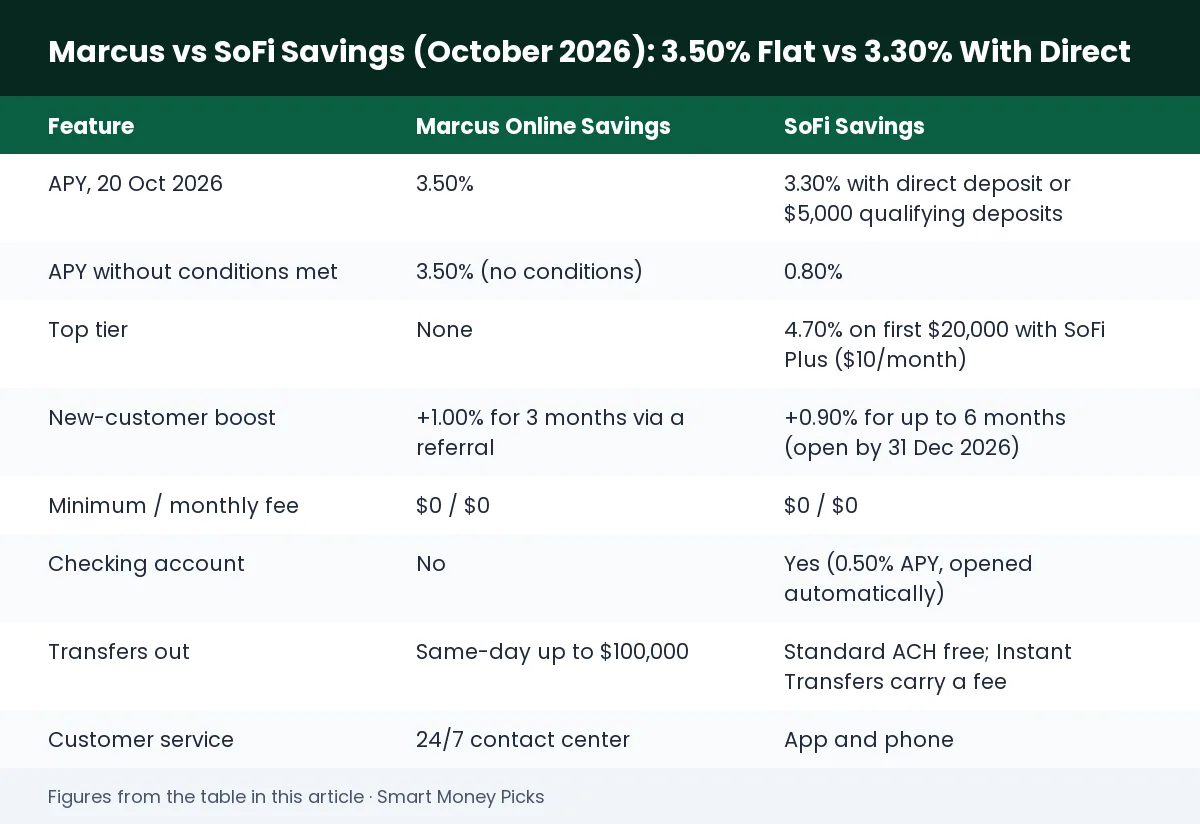
| Feature | Marcus Online Savings | SoFi Savings |
|---|---|---|
| APY, 20 Oct 2026 | 3.50% | 3.30% with direct deposit or $5,000 qualifying deposits |
| APY without conditions met | 3.50% (no conditions) | 0.80% |
| Top tier | None | 4.70% on first $20,000 with SoFi Plus ($10/month) |
| New-customer boost | +1.00% for 3 months via a referral | +0.90% for up to 6 months (open by 31 Dec 2026) |
| Minimum / monthly fee | $0 / $0 | $0 / $0 |
| Checking account | No | Yes (0.50% APY, opened automatically) |
| Transfers out | Same-day up to $100,000 | Standard ACH free; Instant Transfers carry a fee |
| Customer service | 24/7 contact center | App and phone |
| FDIC coverage | $250,000 per depositor, per ownership category | $250,000, or up to $3M through SoFi’s Insured Deposit Program |
How we compared them
We read both rates from the banks’ own documents on 20 October 2026. Marcus’s savings page states 3.50% APY “as of October 20, 2026”. SoFi’s Bank Rate Sheet is a PDF titled “Rates Effective as of: October 20, 2026”. It lists five tables, one for each kind of customer, and those tables are the source of every SoFi rate in this article. SoFi’s marketing pages still carry a 9/23/2026 date on the 3.30% figure, and the rate sheet confirms it is unchanged.
We don’t hold accounts at either bank, and we haven’t tested their apps. Nothing here comes from hands-on use. We read what each bank commits to in writing, did the arithmetic, and say plainly where a choice comes down to taste.
The rate, and the strings attached
Marcus: one rate, no conditions
Marcus by Goldman Sachs pays 3.50% APY on its Online Savings Account. There’s no minimum deposit, no monthly fee and no credit check to open. You don’t need to set up direct deposit or keep any balance to get the rate. Marcus’s own FAQ says there’s currently no limit on how many withdrawals or transfers you can make. The fine print adds that “maximum balance limits apply”, which only matters if you’re parking millions.
SoFi: 3.30% if you qualify, 0.80% if you don’t
SoFi Checking and Savings is one account with two parts, and the savings rate depends on what happens in the checking side. According to the rate sheet, you earn the 3.30% savings APY in either of two cases. One is an Eligible Direct Deposit, meaning recurring regular income such as a paycheck. The other is $5,000 or more in Qualifying Deposits within a rolling 31-day period. Moving money between your own SoFi accounts or vaults doesn’t count, and neither do interest or SoFi bonuses.
If neither happens, the rate sheet’s Table 5 applies: 0.80% APY on savings. That’s the most important number in this comparison, because it’s what a SoFi saver earns once a direct deposit lapses or moves to another bank. SoFi re-checks every 31 days, so the drop isn’t permanent. Get your direct deposit back and the 3.30% returns.
What each pays on $5,000, $10,000 and $25,000
These are one-year figures at the 20 October 2026 APYs, assuming the rate holds for a year and the balance doesn’t change. Neither assumption will be exactly true, but the gaps between the columns are what matter.
| Balance | Marcus 3.50% | SoFi 3.30% (qualified) | SoFi 0.80% (not qualified) | SoFi Plus, after $120 fee |
|---|---|---|---|---|
| $5,000 | $175 | $165 | $40 | $115 |
| $10,000 | $350 | $330 | $80 | $350 |
| $25,000 | $875 | $825 | $200 | $985 |
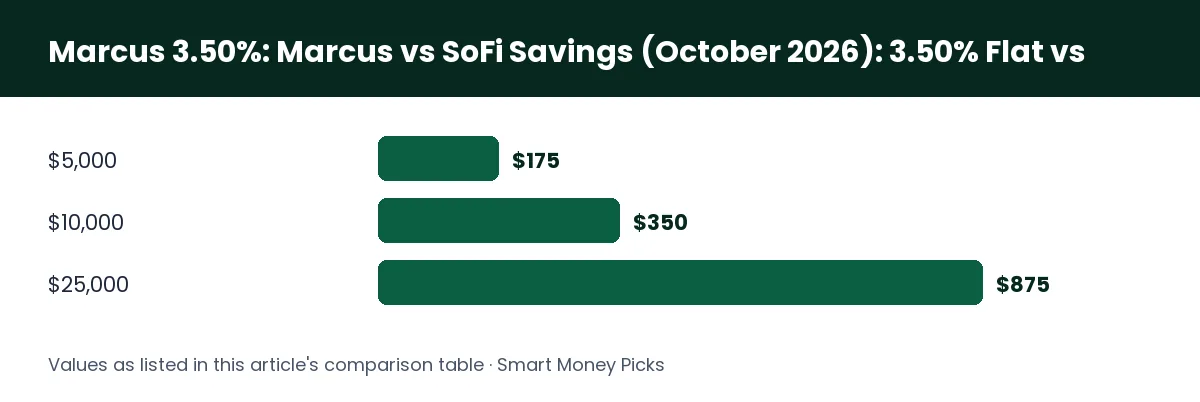
Between Marcus and a qualified SoFi account, the gap is small: $20 a year per $10,000. Between Marcus and an unqualified SoFi account, it’s $270 per $10,000. Choosing between these two banks matters far less than whether SoFi’s conditions will actually hold for you.
The SoFi Plus column follows the rate sheet’s tiers. It pays 4.70% on the first $20,000 and 3.30% above that, minus $120 a year in subscription fees. At $25,000 that’s $940 plus $165, less $120, or $985. For a fuller look at what a balance earns at different rates, see how much interest $10,000 actually earns.
SoFi Plus: when 4.70% is worth $10 a month
SoFi Plus is a paid membership. SoFi’s Plus page lists a “$10 subscription fee”, billed monthly. On the savings side it buys a tiered rate. An individual account earns 4.70% on balances up to $20,000 and 3.30% on anything above. Joint-only members get the 4.70% tier on the first $40,000.
Plus adds 1.40 points over the standard 3.30%, on at most $20,000. That caps the extra interest at $280 a year, against a $120 fee. The break-even balance is about $8,600: $120 divided by 1.40%. Below that, Plus costs more than it earns on savings alone. Above $20,000, the gain stops growing at $160 a year net. Plus also carries non-savings perks, like credit-card and loan discounts. Value those separately, not as part of the savings rate.
The rate sheet also makes clear that paying for Plus counts on its own: the Plus tables apply whether or not you have direct deposit. That makes Plus a way around the direct-deposit condition, for a price. At $10,000 it lands at exactly the Marcus figure, $350 a year. So paying SoFi $10 a month just matches what Marcus pays for free.
The new-customer boosts
Both banks are running introductory offers in October 2026, and they work out to roughly the same first-year rate.
- SoFi: new Checking and Savings members who open between 3 September and 31 December 2026 can add a 0.90% APY boost for up to six months, for a top rate of 4.20%. You qualify by receiving an Eligible Direct Deposit or $5,000 in Qualifying Deposits within 60 days, and the boost can’t be stacked on a Plus balance. Separately, SoFi pays a direct-deposit bonus: $50 for $1,000–$4,999.99 of direct deposits within 25 days, or $400 for $5,000 or more. Your first direct deposit has to arrive by 31 December 2026.
- Marcus: refer a friend who’s new to Marcus and you both can get a 1.00% APY boost for three months. Marcus’s own example puts one referral in a year at a combined APY of about 3.75%, assuming the standard rate stays put.
Over the first year on $10,000, each boost comes to roughly $375 if the base rates hold: SoFi from six months at 4.20%, Marcus from three months at 4.50%. The real difference is the SoFi direct-deposit bonus. For someone whose paycheck is $5,000 a month or more, $400 is worth more than either rate boost. That money comes from moving your paycheck, though, so it only counts if you would move it anyway.
Checking, transfers and day-to-day use
SoFi is a whole bank account
Opening SoFi Savings automatically opens a SoFi Checking account in your name, paying 0.50% APY. SoFi charges no account, service or maintenance fees. Its fee sheet does charge for outgoing wires, Instant Transfers and global remittances. In-network withdrawals are free at more than 55,000 Allpoint ATMs. Paychecks can arrive up to two days early. Members with $1,000 or more in eligible direct deposits in a rolling 31 days get up to $50 of overdraft coverage on debit-card purchases. Savings can also be split into “vaults” for separate goals. If you want one app for spending and saving, this is the real argument for SoFi.
Marcus does one job
Marcus offers savings and CDs, with no checking account. You link an account at another bank and move money back and forth. Marcus says same-day transfers to and from other banks are available for amounts of $100,000 or less, and its contact center runs 24 hours a day, 7 days a week. Interest starts the day you initiate a transfer in. If you already like your checking account and just want your savings to earn more somewhere else, that separation is a plus. Money that isn’t one tap from your debit card is harder to spend.
Interest mechanics
SoFi’s rate sheet says interest accrues daily on the end-of-day balance and is compounded and credited monthly. Marcus quotes an APY, which already accounts for compounding, so the two headline rates compare directly.
FDIC insurance: same floor, different ceiling
Marcus deposits are held by Goldman Sachs Bank USA, Member FDIC, insured to the standard $250,000 per depositor, per ownership category. SoFi Bank, N.A. is also Member FDIC at $250,000. Through the SoFi Insured Deposit Program, SoFi spreads larger balances across partner banks so deposits “may be insured up to $3M”. For most savers the standard limit is plenty. If you hold more than $250,000 in cash in one name, SoFi’s program is a real difference. Marcus customers in that position usually split funds across ownership categories or across banks.
Which should you choose?
Choose Marcus if…
- Your paycheck stays at another bank
- You want the rate without having to do anything to keep it
- You prefer savings kept apart from your spending money
- You want same-day transfers up to $100,000 and 24/7 phone support
Choose SoFi if…
- You’ll move your direct deposit there and keep it there
- You want checking, savings and vaults in one app
- You can use the $50–$400 direct-deposit bonus before 31 Dec 2026
- You hold over $250,000 in cash and want the $3M program
The honest limitation on each. Marcus has no checking account, so it can only be your savings bank, never your main bank. SoFi’s headline rate depends on your behavior: lose the direct deposit, and the savings rate quietly drops from 3.30% to 0.80%. If you’re not sure your employer will keep paying into SoFi, take Marcus. A missed condition can cost $270 a year per $10,000, against $20 for the rate gap.
If neither fits, our full high-yield savings comparison covers the other banks paying above 3%. If you won’t need the money for a year or more, CD rates lock in a rate that a savings account can cut at any time. Our earlier Marcus vs Ally comparison covers the other common Marcus matchup. If you’re weighing SoFi’s investing side too, see our SoFi Invest review.
Frequently asked questions
Is Marcus or SoFi better for savings?
On rate alone, Marcus: 3.50% with no conditions against SoFi’s 3.30%, which needs direct deposit or $5,000 in qualifying deposits every 31 days (rates as of 20 October 2026). SoFi is better if you want a full bank in one app and your paycheck already goes there.
What does SoFi pay without direct deposit?
0.80% APY on savings, per SoFi’s rate sheet dated 20 October 2026 (Table 5). It applies when you have no Eligible Direct Deposit, haven’t made $5,000 in Qualifying Deposits within 31 days, and don’t pay for SoFi Plus.
Is SoFi Plus worth it for the 4.70% rate?
Only on savings above about $8,600. Plus costs $10 a month and adds 1.40 points on up to $20,000, so the most it can add is $160 a year after the fee. At $10,000 it nets the same $350 that Marcus pays with no fee.
Does Marcus have a checking account?
No. Marcus offers an Online Savings Account and CDs. You keep checking at another bank and move money with linked transfers, which Marcus says can arrive the same day for $100,000 or less.
Are Marcus and SoFi FDIC insured?
Yes. Marcus deposits are held by Goldman Sachs Bank USA, Member FDIC, and SoFi Bank, N.A. is Member FDIC. Both are insured to $250,000 per depositor, per ownership category. SoFi’s Insured Deposit Program can extend coverage to as much as $3 million by spreading deposits across partner banks.
Will these rates change?
Yes. Both are variable and can change at any time, before or after you open the account. SoFi’s introductory 0.90% boost lasts up to six months, and Marcus’s referral boost lasts three months. After that, each account earns its then-current standard rate. Recheck both banks’ pages before deciding.
About the author. Lennit Herrera is the founder and editor of Smart Money Picks. He is not a financial adviser, and this article is information, not financial advice. Whether either account suits you is a question for a qualified professional. Rates were read at each bank on 20 October 2026 and are variable. Smart Money Picks has no affiliate relationship with Marcus or SoFi, and the links above are plain links.