Best Money Market Accounts of October 2026: Up to 4.05% APY
Some links on this page may become affiliate links, meaning we may earn a commission at no extra cost to you. See our affiliate disclosure. Editorial placement is decided on merit and is not for sale.
By Lennit Herrera, founder and editor, Smart Money Picks · Last updated October 25, 2026
The verdict: ZYNLO Bank has the best money market account this month, at 4.05% APY with no minimum deposit, no monthly fee and no limit on transactions. That is more than six times the FDIC’s national money market average of 0.63%. If you want a money market account that works like a checking account, with a free debit card and paper checks, Quontic Bank pays 3.90% APY on every balance and asks for $100 to open. New customers at UFB Direct can get a boosted 4.01% APY for up to six months, but only if they open by October 31, 2026, and the rate drops to 3.26% after that.
Rates read on each bank’s own website on October 25, 2026. ZYNLO dates its money market APY October 10, 2026; Quontic’s rate sheet lists its money market rate as last updated September 1, 2026; Ally and UFB date theirs October 25, 2026; Sallie Mae’s page dates its rate October 26, 2026. The national average comes from the FDIC’s October 2026 National Rates and Rate Caps table.
Money market rates are variable and can change after you open the account. Check the current APY on the bank’s site before you move money. This article is general information, not financial advice.
On this page
- The short list: six picks at a glance
- Comparison table: APY, minimums, fees, access
- How we picked
- 1. ZYNLO Bank: best overall rate
- 2. Quontic Bank: best for checks and a debit card
- 3. Sallie Mae Bank: best for no minimums anywhere
- 4. UFB Direct: best new-customer promo
- 5. Ally Bank: best ATM access
- 6. Synchrony Bank: best for existing Synchrony customers
- Which money market account is right for you
- What $10,000 earns in each account
- How money market accounts work
- Is your money safe? FDIC coverage explained
- What didn’t make the list, and why
- When a money market account is the wrong choice
- Frequently asked questions
The short list
- ZYNLO Bank: best overall rate, at 4.05% APY with no minimum deposit and no monthly fee.
- Quontic Bank: best for checks and a debit card, at 3.90% APY on every balance tier.
- Sallie Mae Bank: best for no minimums anywhere, at 3.60% APY with check writing.
- UFB Direct: best new-customer promo, at 4.01% APY for up to six months (3.26% APY standard) if you open by October 31.
- Ally Bank: best ATM access, at 3.20% APY with a debit card, checks and 75,000+ fee-free ATMs.
- Synchrony Bank: best only if you already bank there, at 2.00% APY with checks and ATM access.
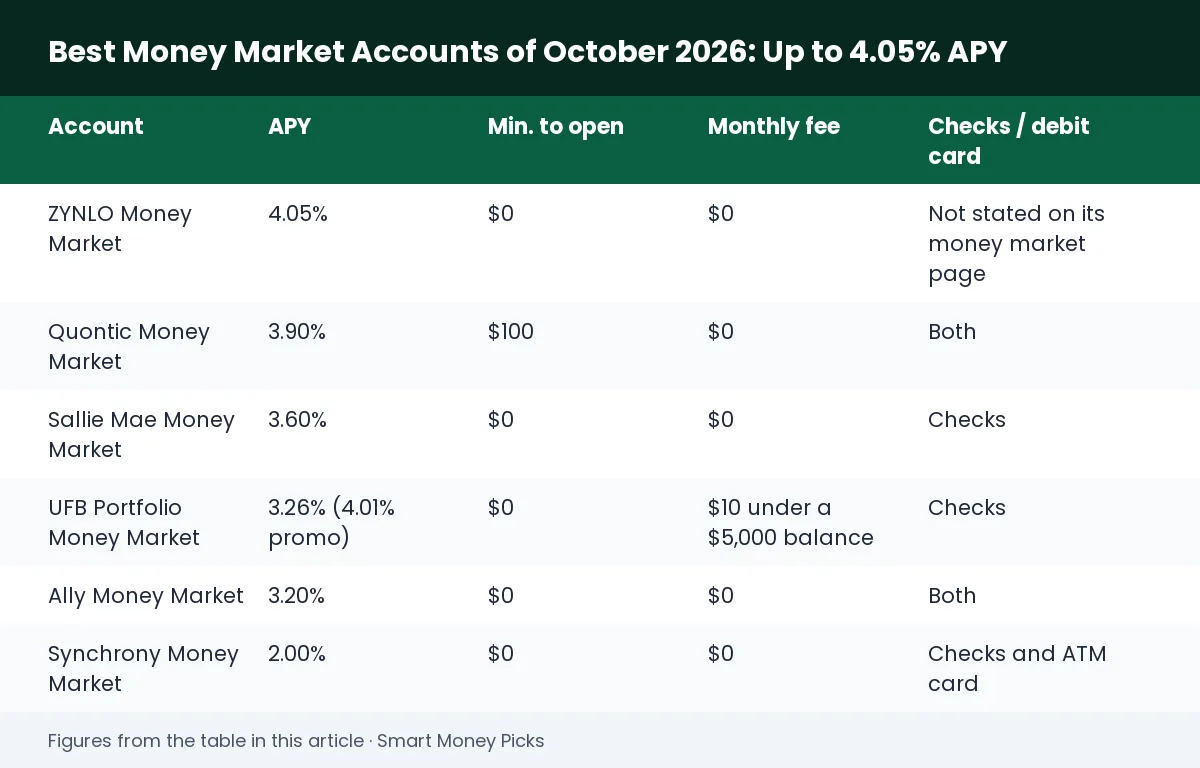
Comparison table
| Account | APY | Min. to open | Monthly fee | Checks / debit card | Rates |
|---|---|---|---|---|---|
| ZYNLO Money Market | 4.05% | $0 | $0 | Not stated on its money market page | See rate → |
| Quontic Money Market | 3.90% | $100 | $0 | Both | See rate → |
| Sallie Mae Money Market | 3.60% | $0 | $0 | Checks | See rate → |
| UFB Portfolio Money Market | 3.26% (4.01% promo) | $0 | $10 under a $5,000 balance | Checks | See rate → |
| Ally Money Market | 3.20% | $0 | $0 | Both | See rate → |
| Synchrony Money Market | 2.00% | $0 | $0 | Checks and ATM card | See rate → |
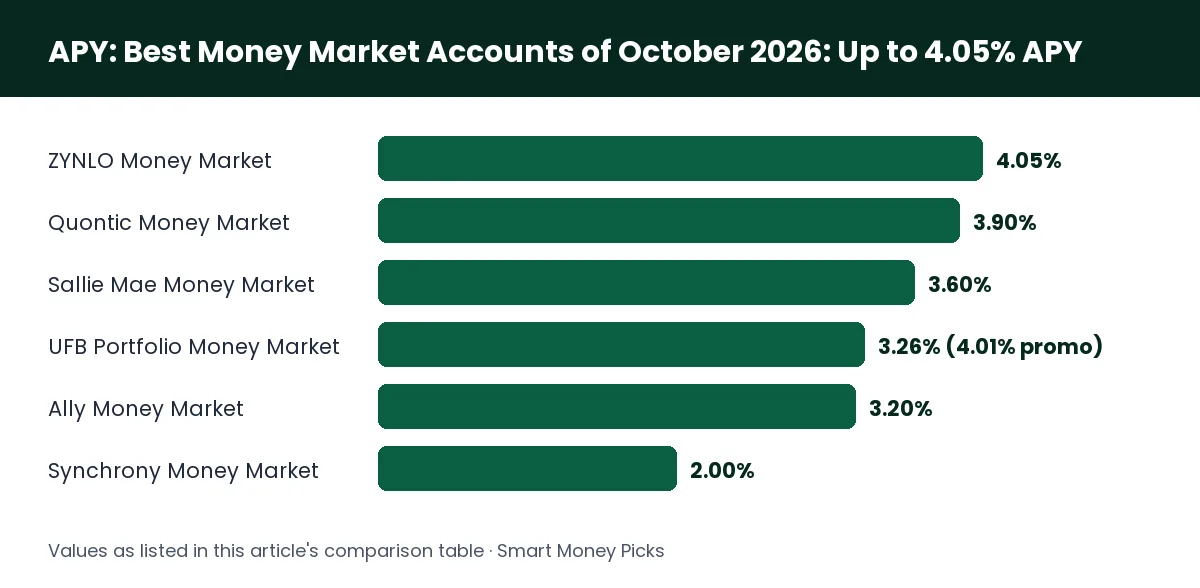
APYs as printed on each bank’s site on October 25, 2026. For comparison, the FDIC’s national average for money market accounts is 0.63%.
How we picked
We looked at 11 money market accounts from online banks that let you open an account nationwide: ZYNLO, Quontic, Sallie Mae, UFB Direct, Ally, Synchrony, CIT Bank, Vio Bank, EverBank, Discover and Capital One. For each one we went to the bank’s own product page, rate sheet or account disclosure on October 25, 2026, and recorded the APY, the minimum to open, the minimum balance to earn the APY, the monthly fee, and whether the account comes with checks or a debit card. Six accounts made the list. The other five are covered in what didn’t make the list, with the reason for each.
We ranked mainly on the standard APY, because that is the rate you will earn after any promotion ends. Then we weighed the things that decide whether a money market account is actually useful: whether you can get at the money with checks or a debit card, whether a fee or a minimum can eat into the interest, and whether the bank prints a date next to its rate. A bank that shows a current, dated APY in public is easier to hold to that rate than one that hides it behind an application.
We do not open or test accounts ourselves. Every figure on this page comes from the bank’s own published disclosures, or from the FDIC for national averages and insurance rules, and every figure is dated. If a bank’s site wouldn’t load or wouldn’t let us read the rate, we left the bank off rather than copy a number from another review site.
1. ZYNLO Bank: best overall rate
- APY: 4.05% (valid as of October 10, 2026, per ZYNLO)
- Min. balance for APY: $0.01
- Min. deposit to open: $0
- Monthly fee: $0, regardless of balance
- Checks / debit card: Not stated on its money market page
- FDIC insured: Yes, as a division of PeoplesBank, Holyoke, Massachusetts
Why ZYNLO? It pays the highest standard rate we found, and it does it without any of the usual strings. Its disclosure says there is no minimum deposit to open, the minimum balance to earn the APY is one cent, and there is no monthly maintenance charge at any balance. ZYNLO also says the account has no limit on transactions, which is unusual: many money market accounts still cap certain withdrawals each month, and Ally’s, below, closes accounts that go over its limit too often. ZYNLO is the digital brand of PeoplesBank, a Massachusetts bank, so the money sits at a regulated, FDIC-insured bank even though you only deal with an app and a website.
What we like
- 4.05% APY, the highest standard money market rate among the accounts we checked.
- No minimum to open, a one-cent minimum to earn the APY, and no monthly fee.
- No transaction limits, per its own product page.
- The rate is dated on the page, so you can see when it was last set.
Watch out for
- ZYNLO’s own savings account pays more. Its Tomorrow Savings account is listed at 4.10% APY on the same site. If you don’t need money market features, the savings account is the better ZYNLO choice.
- Its money market page doesn’t say whether the account comes with paper checks or a debit card. If you want to pay bills straight from the account, ask before you open it, or pick Quontic.
- ZYNLO and PeoplesBank are one bank for FDIC purposes. If you already hold money at PeoplesBank, the two balances count together toward the same $250,000 limit.
Best for: savers who want the top rate with no minimum and no fee. Skip it if: you need checks or a debit card on the account itself.
See ZYNLO’s current money market rate →
2. Quontic Bank: best for checks and a debit card
- APY: 3.90% on every balance tier (rate sheet: last updated September 1, 2026)
- Min. balance for APY: $0.01
- Min. deposit to open: $100
- Monthly fee: $0
- Checks / debit card: Both, plus Zelle
- FDIC insured: Yes, Quontic Bank
Why Quontic? Quontic describes its money market account as “a checking account that offers a debit card and check-writing privileges”, and that is the point of picking it. You get 3.90% APY, only 0.15 points below ZYNLO, on an account you can actually spend from: a free debit card, paper checks and Zelle. Its rate sheet lists three balance tiers (up to $4,999.99, $5,000 to $149,999.99, and over $149,999.99), and all three pay the same 3.83% interest rate and 3.90% APY, so a small balance earns as much as a large one. The $100 opening deposit is not an ongoing minimum; the rate sheet says there is no minimum daily balance and no maintenance fee.
What we like
- 3.90% APY at every balance, with a debit card and checks included.
- No monthly fee and no ongoing minimum balance.
- Zelle is available on the money market account (Quontic says it is not on its high-yield savings account).
- A public rate sheet with the interest rate, APY and date for every tier.
Watch out for
- You need $100 to open. Every other account on this list opens with $0.
- The rate sheet shows the money market rate last updated September 1, 2026. It is still a variable rate, and Quontic says it can change without notice.
- Quontic’s site notes that if you close the account before interest is credited for the month, you can lose that month’s accrued interest.
Best for: anyone who wants one account that earns a high rate and pays bills. Skip it if: you only want the highest rate and never write checks.
See Quontic’s current money market rate →
3. Sallie Mae Bank: best for no minimums anywhere
- APY: 3.60% (dated October 26, 2026 on Sallie Mae’s page)
- Min. balance for APY: $0
- Min. deposit to open: $0
- Monthly fee: $0
- Checks / debit card: Checks
- FDIC insured: Yes, Sallie Mae Bank
Why Sallie Mae? Its money market account removes every threshold: no minimum deposit, no minimum balance and no monthly maintenance fee, stated three separate times on its own page. You can write checks from the account, interest compounds daily and is paid monthly, and Sallie Mae says there are no transaction fees. Most people know Sallie Mae for student loans, but Sallie Mae Bank is a separate, FDIC-insured bank that has offered online savings products for years. At 3.60% APY it sits in the middle of this list, which makes it a solid, plain choice if you want check access and nothing to keep track of.
What we like
- No minimum deposit, no minimum balance and no monthly fee.
- Check writing from the account.
- Daily compounding, paid monthly.
Watch out for
- Sallie Mae’s own high-yield savings account pays more, at 4.00% APY. If you don’t need checks, that is the better Sallie Mae account.
- There is a $20 fee for outgoing wire transfers. Use a free ACH transfer instead when you can.
- Its money market page mentions checks but not a debit card, so don’t count on card access.
Best for: savers who want check access and no rules to track. Skip it if: you want the highest rate, or a debit card.
See Sallie Mae’s current money market rate →
4. UFB Direct: best new-customer promo
- APY: 3.26% standard on every tier; 4.01% for up to six months for new customers with code UFB75 (offer ends October 31, 2026)
- Min. balance for APY: $0
- Min. deposit to open: $0
- Monthly fee: $10, waived with a $5,000 balance
- Checks / debit card: Checks
- FDIC insured: Yes, through Axos Bank (FDIC cert. 35546)
Why UFB? For the next few days, UFB has the highest rate you can lock in for a few months. Its Portfolio Money Market pays 3.26% APY on every balance tier, and new UFB customers who open with promo code UFB75 get a 0.75-point boost to 4.01% APY for up to six months. UFB’s page says the offer ends October 31, 2026. The account also has check writing. UFB Direct is a brand of Axos Bank, and its page states that all UFB deposits are insured through Axos Bank under FDIC certificate 35546.
What we like
- 4.01% APY for up to six months for new customers, the highest promo rate we found.
- The same 3.26% APY at every balance after the promotion.
- Check writing on the account.
Watch out for
- The boost is temporary and the deadline is close. After six months you earn 3.26% APY, which is below Quontic, Sallie Mae and ZYNLO’s standard rates. The offer ends October 31, 2026.
- There is a $10 monthly fee if your balance is under $5,000. On a $2,000 balance, that fee would cost more than the account earns.
- UFB deposits are combined with any money you hold at Axos Bank or its other brands for the $250,000 FDIC limit.
Best for: new customers with $5,000 or more who will open before October 31. Skip it if: your balance will dip under $5,000, or you want the best rate after the promo ends.
See UFB’s current money market rate →
5. Ally Bank: best ATM access
- APY: 3.20% on all balance tiers (accurate as of October 25, 2026, per Ally)
- Min. balance for APY: $0
- Min. deposit to open: $0
- Monthly fee: $0
- Checks / debit card: Both
- FDIC insured: Yes, Ally Bank
Why Ally? Ally’s money market account comes with a debit card and checks, and the card works at any Allpoint or MoneyPass ATM in the U.S. for free, more than 75,000 machines by Ally’s count, with unlimited ATM withdrawals. Ally charges no monthly maintenance fee and no fees for standard or expedited ACH transfers or incoming wires. Its rate, 3.20% APY, is the same at every balance tier, and Ally prints the date next to it. If you already use Ally for checking or savings, keeping the money market account in the same app makes transfers instant.
What we like
- Debit card and checks, with free withdrawals at 75,000+ ATMs.
- No monthly fee and no minimum balance.
- The same APY at every balance, with a dated rate.
Watch out for
- There’s a limit of 10 withdrawals per statement cycle, not counting ATM withdrawals. Ally doesn’t charge for going over, but it says it will close the account if you exceed the limit more than occasionally.
- At 3.20% APY, it pays 0.85 points less than ZYNLO. On $10,000 that’s about $85 a year.
- Ally’s money market account doesn’t have the savings “buckets” and “boosters” that its savings account has.
Best for: people who want ATM cash access from their savings. Skip it if: you make more than 10 non-ATM withdrawals a month.
See Ally’s current money market rate →
6. Synchrony Bank: best for existing Synchrony customers
- APY: 2.00% (accurate as of October 25, 2026, per Synchrony)
- Min. balance for APY: $0
- Min. deposit to open: $0
- Monthly fee: $0
- Checks / debit card: Checks, plus ATM withdrawals
- FDIC insured: Yes, Synchrony Bank (FDIC cert. 27314)
Why Synchrony? We include it because many readers already have a Synchrony CD or savings account, and they deserve a straight answer. Synchrony’s money market account has no minimum deposit, no minimum balance and no monthly fee, and you can write checks and withdraw money online, by phone or at an ATM. But the rate is the weakest here: 2.00% APY, against 3.55% APY on Synchrony’s own high-yield savings account. Synchrony’s own comparison shows 2.00% is still far above big-bank money market rates, but it is about half of ZYNLO’s.
What we like
- No minimum deposit, no minimum balance and no monthly fee.
- Checks and ATM access in one account.
- Easy to add if you already hold Synchrony CDs or savings.
Watch out for
- Its own high-yield savings account pays 1.55 points more. Unless you’ll write checks often, the savings account is the better Synchrony home for cash.
- At 2.00% APY, $10,000 earns about $205 less per year than at ZYNLO’s 4.05%.
Best for: existing Synchrony customers who need check writing. Skip it if: you’re opening a new account anywhere; every other pick here pays more.
See Synchrony’s current money market rate →
Which money market account is right for you
You want the highest rate and don’t write checks: ZYNLO at 4.05% APY. Before you settle on a money market account at all, compare it with the best high-yield savings accounts. ZYNLO’s and Sallie Mae’s own savings accounts both pay more than their money market accounts.
You want to pay bills or use a card straight from your savings: Quontic. You get 3.90% APY, a debit card, checks and Zelle, and only $100 to open.
You want ATM cash access: Ally, with free withdrawals at more than 75,000 Allpoint and MoneyPass ATMs. Mind the 10-withdrawal limit on other transfers.
You’re new to a bank, have $5,000 or more, and can open this week: UFB‘s 4.01% APY promo pays the most for the first six months. Set a reminder for month six, when the rate falls to 3.26%, and compare again then.
You want no minimums and no rules at all: Sallie Mae, with no minimum deposit, no minimum balance, no monthly fee and check writing.
You already bank at Synchrony: its money market account is easy to add, but its 3.55% APY high-yield savings account is the better place for money you won’t spend by check.
You’re building an emergency fund: any of the top four works. What matters most is that the money is separate from your checking account and easy to reach in a day or two. Our emergency fund guide covers how much to keep and where.
What $10,000 earns in each account
APY already includes compounding, so a year’s interest on a steady balance is roughly the balance times the APY. Here’s what $10,000 would earn in a year at each account’s current rate, if the rate didn’t change. Money market rates are variable, so treat these as estimates, not promises.
| Account | APY | Interest on $10,000 in 1 year |
|---|---|---|
| ZYNLO | 4.05% | About $405 |
| Quontic | 3.90% | About $390 |
| UFB (6 months at 4.01%, then 3.26%) | 4.01% then 3.26% | About $364 |
| Sallie Mae | 3.60% | About $360 |
| Ally | 3.20% | About $320 |
| Synchrony | 2.00% | About $200 |
| FDIC national average | 0.63% | About $63 |
The gap between the top account and the national average is about $340 a year on $10,000. Between the top account and the sixth, it’s about $205. For more examples at other balances, see how much interest $10,000 earns and where to park $10,000.
How money market accounts work
A money market account is a bank deposit account. It pays a variable interest rate like a savings account, and it often adds some checking-account tools, such as paper checks, a debit card or an ATM card. It’s insured by the FDIC like any other deposit at an insured bank. It is not the same thing as a money market fund, which is an investment you buy through a brokerage. A fund is not FDIC-insured, though brokerages usually cover cash under SIPC rules instead.
Rates are variable. The bank can raise or lower the APY at any time after you open the account, and most say so in their disclosures. That’s why every rate on this page carries a date. A rate that was set weeks ago, like Quontic’s September 1 rate, is still the current rate, but it’s worth checking again before you open.
Tiers. Some banks pay different rates at different balances. All six accounts here pay the same APY at every balance tier they list. The exception is UFB’s monthly fee, which applies below $5,000.
Withdrawal limits. The federal six-withdrawal rule (Regulation D) was suspended in 2020. Banks are now free to set their own limits, and some keep one anyway. Ally caps non-ATM withdrawals at 10 per statement cycle. ZYNLO says it has no limit. Check the account agreement if you’ll move money often.
Money market vs high-yield savings. Today, a high-yield savings account often pays as much or more than a money market account at the same bank. ZYNLO, Sallie Mae and Synchrony all pay more on savings. What you’re paying for with a money market account is access: checks and sometimes a card. We compare the two in detail in money market vs high-yield savings. If you can leave the money alone for a fixed period, the best CD rates may also beat both. See high-yield savings vs CD for how to choose.
Is your money safe? FDIC coverage explained
Every account on this list is held at an FDIC-insured bank. The FDIC covers up to $250,000 per depositor, per insured bank, for each account ownership category, so a joint account has its own coverage separate from an individual one. The FDIC’s deposit insurance page explains the categories.
Two picks here are brands of a larger bank, and that affects your limit:
- ZYNLO is a division of PeoplesBank. Money at ZYNLO and PeoplesBank counts together toward one $250,000 limit.
- UFB Direct is a brand of Axos Bank. UFB’s own page says deposits at UFB and other Axos brands are combined and insured under the same certificate, 35546.
If you’re holding more than $250,000 in one ownership category, split it across separately chartered banks, or add a joint or trust account. You can confirm any bank’s status in the FDIC’s BankFind tool before you deposit.
What didn’t make the list, and why
- CIT Bank Money Market. CIT’s website showed a system-maintenance page on October 25, 2026, so we couldn’t read its current money market rate. We won’t list a rate we can’t see on the bank’s own site. We’ll add CIT when we can verify it. Our CIT Bank Platinum Savings review covers its savings account.
- Vio Bank Cornerstone Money Market. Vio’s site returned a bot-check page instead of its rates when we checked, so its rate is unverified and it’s left off.
- EverBank Performance Money Market. EverBank’s site says the account is available only through its financial centers, so it isn’t open to most readers nationwide.
- Discover. Discover’s money market page now loads Capital One’s 360 Performance Savings page instead, so there was no Discover money market account to compare.
- Capital One. We found no money market account on its site. Its 360 Performance Savings account pays 3.20% APY, the same as Ally’s money market account.
When a money market account is the wrong choice
When the same bank’s savings account pays more. That’s true at three of our six picks. If you’ll never write a check from it, a high-yield savings account is usually the better deal.
When you can leave the money alone. If you know you won’t need the money for a year or more, a CD locks in a rate, and the bank can’t lower it. See our best CD rates for current terms.
When the money is for investing over the long term. A money market account is for cash you may need soon. For money you won’t touch for five years or more, cash usually loses ground to inflation over time. Our guide to investing in index funds covers the next step.
When your balance will sit below a fee threshold. UFB’s $10 monthly fee under $5,000 can wipe out the interest on a small balance. Pick a no-fee account instead.
Frequently asked questions
What is the best money market account rate right now?
Among the accounts we checked on October 25, 2026, ZYNLO paid the highest standard rate, at 4.05% APY, with no minimum and no monthly fee. UFB Direct’s promo pays 4.01% APY for up to six months to new customers who open by October 31, 2026, then 3.26% APY. The FDIC’s national average for money market accounts was 0.63% in October 2026.
Are money market accounts FDIC insured?
Yes, if they’re at an FDIC-insured bank. A money market account is a bank deposit and is covered up to $250,000 per depositor, per bank, for each ownership category. A money market fund is an investment, not a deposit, and isn’t FDIC-insured.
Is a money market account better than a high-yield savings account?
Only if you’ll use the checks or the debit card. On rate alone, savings often wins. ZYNLO’s savings account pays 4.10% APY against 4.05% on its money market account. Sallie Mae’s pays 4.00% against 3.60%, and Synchrony’s pays 3.55% against 2.00%. See money market vs high-yield savings for the full comparison.
Can I lose money in a money market account?
Not from the balance itself, if you stay under the FDIC limit at an insured bank. You can lose interest to fees, like UFB’s $10 monthly fee under $5,000 or Sallie Mae’s $20 outgoing wire fee. And if the rate falls below inflation, your money buys less over time.
How much should I keep in a money market account?
For most people, it’s the emergency fund plus any money for spending in the next year or two. Many planners suggest three to six months of expenses for an emergency fund. Anything beyond what you’ll need soon usually belongs in a CD or a long-term investment instead.
Do money market accounts limit withdrawals?
Some do. The federal six-withdrawal limit was lifted in 2020, but banks can set their own. Ally allows up to 10 non-ATM withdrawals per statement cycle and can close accounts that exceed this often. ZYNLO says its money market account has no transaction limits.
How often do money market rates change?
Whenever the bank decides. The rates are variable, and banks usually move them after the Federal Reserve changes its benchmark rate. Quontic’s rate sheet shows its rate unchanged since September 1, 2026. ZYNLO dated its rate October 10, 2026. Check the bank’s own page on the day you open.
Bottom line
ZYNLO’s 4.05% APY money market account is the best this month: no minimum, no monthly fee and no transaction limit. If you want to spend straight from the account, Quontic pays 3.90% APY with a debit card, checks and Zelle. UFB’s 4.01% APY promo is worth a look only if you’re a new customer, will keep $5,000 or more in it, and can open by October 31. Before you choose any money market account, compare it with the same bank’s savings account. At three of these six banks, savings pays more.
About the author
Lennit Herrera is the founder and editor of Smart Money Picks, and builds and audits websites for a living. Lennit is not a licensed financial adviser, and nothing here is personal financial advice. We do not open or test accounts. Rates and fees come from the banks’ own disclosures or named public sources such as the FDIC, and each one is dated. Corrections are welcome through our contact page.
Related reads